
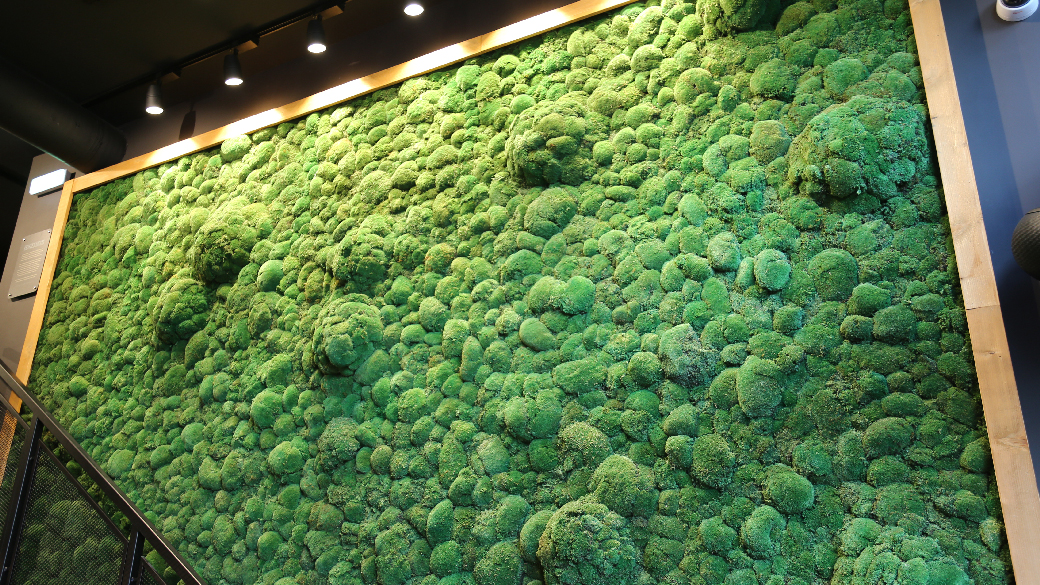
A large preserved cushion moss wall creates a striking natural feature without watering or regular plant maintenance.
A moss wall brings natural greenery into an interior without the care requirements of a conventional living wall. Made from real preserved moss, it retains its natural appearance without watering, fertilising or regular trimming.
This makes preserved moss particularly suitable for offices, reception areas, hotels, shops and private interiors where greenery is desired but ongoing plant maintenance is not practical.
However, “maintenance-free” does not mean that a moss wall is completely unaffected by its surroundings. The right indoor location, suitable humidity and protection from direct sunlight all help preserve its appearance for as long as possible.
In this guide, we explain how preserved moss walls work, which moss types are available and what you should consider when choosing the right solution for your space.
Post Contents [hide]
- What Does a Maintenance-Free Moss Wall Actually Mean?
- Preserved Moss vs Living Moss Walls
- Which Type of Moss Is Best for Which Space?
- Choosing the Right Location for a Long-Lasting Moss Wall
- Moss Wall or Framed Moss Picture?
- Moss Logos and Lettering for Businesses
- How Do You Clean a Preserved Moss Wall?
- Frequently Asked Questions About Maintenance-Free Moss Walls
- Conclusion: Natural Greenery Without Regular Plant Care
What Does a Maintenance-Free Moss Wall Actually Mean?
A maintenance-free moss wall is usually made from real moss that has been preserved. During the preservation process, the natural moisture inside the moss is replaced with a special preserving solution. This allows the moss to retain much of its natural texture, flexibility and colour without continuing to grow.
Unlike a living moss wall, preserved moss therefore does not require:
- watering,
- fertilising,
- soil or substrate,
- artificial plant lighting,
- pruning,
- or an irrigation system.
This makes it especially practical for interiors where regular plant care would be difficult or expensive.
At the same time, preserved moss remains a natural material. Direct sunlight, excessive heat, contact with water and unsuitable humidity can affect its colour and texture over time.
A maintenance-free moss wall is therefore best understood as a natural decorative surface that requires no horticultural care, rather than as a completely indestructible wall covering.
If you would like to explore different formats and moss designs, you can also discover our preserved moss pictures, moss walls and moss letters.
Preserved Moss vs Living Moss Walls
At first glance, a preserved moss wall and a living green wall can look quite similar. In everyday use, however, the two systems are very different.
A living moss or plant wall contains actively growing plants. Depending on the design, it may require regular watering, irrigation technology, suitable lighting, nutrient supply and ongoing plant care. This can also result in additional maintenance and operating costs.
Living wall systems also need to be professionally planned and maintained. Irrigation systems, reservoirs, substrates and concealed cavities can create problems if moisture accumulates or maintenance is neglected.
A preserved moss wall, by contrast, no longer grows. The moss has been treated so that its natural appearance is retained without water or nutrients. It can therefore also be used in areas with little natural daylight, such as corridors, meeting rooms, waiting areas and interior commercial spaces.
Key Differences at a Glance
| Preserved moss wall | Living green wall |
|---|---|
| No watering required | Requires a regular water supply |
| No fertiliser needed | Nutrients may be necessary |
| No plant lighting required | Suitable light conditions are important |
| No pruning or growth control | Regular plant maintenance may be required |
| Suitable for many indoor areas | Room conditions must support living plants |
| Preserved natural material | Actively growing plant system |
The feel of preserved moss can change slightly with the indoor climate. In dry air it may become firmer, while higher humidity can make it feel softer again. This is a natural characteristic of the material and does not mean that the moss needs to be watered.
Which Type of Moss Is Best for Which Space?
The choice of moss influences not only the appearance of a wall but also its texture, depth and sensitivity.
Cushion Moss – Natural Depth and a Three-Dimensional Look
Cushion moss forms soft, rounded mounds that create a pronounced three-dimensional surface. A wall made from cushion moss therefore has noticeable depth and a particularly natural, landscape-like appearance.
It is comparatively robust and less delicate than reindeer moss, making it particularly suitable for:
- larger moss walls,
- three-dimensional moss pictures,
- reception areas,
- offices and meeting rooms,
- hotels and restaurants,
- and representative interiors.
For a particularly sculptural effect, a preserved cushion moss picture can also be used instead of covering an entire wall.
Reindeer Moss – Fine Texture and Flexible Design
Reindeer moss, often referred to as Iceland moss in decorative product descriptions, has a much finer, branched structure. It creates a lighter and more delicate surface than cushion moss.
Its fine structure makes it particularly suitable for:
- moss logos,
- lettering and company names,
- smaller decorative areas,
- framed moss pictures,
- and detailed designs.
However, its delicate branches also make it more sensitive. In very dry conditions it can become brittle more quickly, while unsuitable lighting may cause the colour to fade sooner than with cushion moss.
An example of this lighter structure is our Iceland moss wall art, available in several formats.
Flat Moss – Calm and Even Surfaces
Flat moss creates a relatively smooth and even surface. Compared with cushion moss, it produces less depth and therefore appears quieter and more restrained.
It works particularly well in minimalist interiors and combines naturally with materials and colours such as wood, black, beige, stone and warm neutral tones.
Different moss varieties can also be combined to create a more varied relief. However, additional preserved plants or delicate decorative elements should be used selectively, as highly detailed surfaces can collect more dust over time.
Choosing the Right Location for a Long-Lasting Moss Wall
Although preserved moss does not need water or plant care, the surrounding conditions still influence how well it retains its colour and texture.
A preserved moss wall should always be installed indoors in a protected environment.
Avoid Direct Sunlight
Preserved moss does not need daylight to survive because it is no longer growing. Strong direct sunlight should actually be avoided, as UV exposure can cause colours to change or fade over time – particularly with more delicate reindeer moss.
Keep It Away from Water
Preserved moss should never be watered or sprayed. Direct contact with water can affect the preservation treatment and alter the texture or colour of the material.
In kitchens and bathrooms, ventilation is particularly important. Occasional humidity is generally less problematic than constant steam, condensation or a permanently damp indoor climate.
Keep Some Distance from Heat Sources
Locations immediately above radiators, next to fireplaces or directly in strong warm airflow are not ideal. Very dry air can cause preserved moss to feel firmer and may make delicate moss varieties more brittle.
Suitable locations include:
- living and dining rooms,
- bedrooms,
- hallways,
- home offices,
- meeting rooms,
- reception areas,
- practices,
- hotels,
- restaurants,
- and commercial interiors.
In publicly accessible areas, it is also worth considering how easily visitors can touch the moss. Positioning the installation above a sideboard, behind a reception desk or slightly higher on the wall can help prevent accidental damage.
Moss Wall or Framed Moss Picture?
A complete moss wall can create a striking architectural feature, but it is not always necessary. Depending on the size and function of the room, a framed moss picture may offer many of the same visual benefits with greater flexibility.
A moss picture is particularly useful when:
- only part of a wall should be highlighted,
- the design may need to be moved later,
- the available wall space is limited,
- or a clearly defined decorative element is preferred.
Large moss pictures can still have a strong visual presence and work particularly well above a sideboard, in a reception area, behind a desk or in a meeting room.
A full moss wall, by contrast, becomes part of the architecture itself. It is especially effective behind a reception desk, as a calm background in a conference room or as a feature wall in a hotel, restaurant or concept store.
Colour should also be considered as part of the overall interior. Lighter greens create a fresh and contemporary impression, while deeper forest tones often feel calmer and more elegant. Natural greens combine particularly well with wood, linen, ceramic, stone and brass.
Moss Logos and Lettering for Businesses
Preserved moss can also be used for logos, company names and individual lettering, making it an attractive design option for reception areas, offices, restaurants, cafés, studios and retail spaces.
A moss logo combines corporate identity with a natural, handcrafted appearance while avoiding the maintenance requirements of living plants.
Depending on the design, lettering can be:
- covered completely with moss,
- combined with contrasting materials,
- mounted individually on the wall,
- or integrated into a larger moss installation.
Reindeer moss is particularly useful for detailed lettering because its finer structure allows relatively precise contours. Cushion moss creates more volume and can work well for larger, bolder elements.
Size, proportion and readability should always be considered carefully. Very fine lines or small details within a company logo may need to be simplified so that the finished design remains clearly recognisable from a distance.
You can find examples and further inspiration for moss letters, logos and custom moss designs in our preserved moss collection.
How Do You Clean a Preserved Moss Wall?
One of the advantages of a preserved moss wall is that regular cleaning is usually unnecessary. On vertical surfaces in protected interiors, dust tends to accumulate relatively slowly.
However, the correct cleaning method depends on the type of moss.
Cleaning Cushion Moss
Cushion moss is comparatively robust. If visible surface dust develops, it can be removed very carefully using a handheld vacuum cleaner on its lowest setting and from a sufficient distance.
The moss should never be strongly suctioned or touched directly with the vacuum cleaner.
Cleaning Reindeer Moss
Reindeer moss requires significantly more care. Its fine branches can break if they are exposed to strong suction, brushes or compressed air.
For this reason, unnecessary cleaning should be avoided wherever possible. Prevention through a suitable location is preferable to frequent mechanical cleaning.
What Should You Avoid?
For all preserved moss varieties, avoid:
- water or misting,
- damp cloths,
- household cleaning products,
- strong vacuum suction,
- compressed air on delicate moss,
- direct sunlight,
- strong heat,
- and frequent touching.
If cushion moss becomes noticeably faded after several years, professional colour refreshing may sometimes be possible. This should be carried out carefully so that the moss is not damaged or left with uneven colouring.
Protecting the surface from direct sunlight, water, excessive heat and frequent contact is therefore the most effective form of “care”.
Frequently Asked Questions About Maintenance-Free Moss Walls
Does a preserved moss wall need watering?
No. Preserved moss should never be watered or sprayed with water. It is no longer a living plant and therefore does not need irrigation, soil or nutrients.
How long does a preserved moss wall last?
A high-quality preserved moss wall can remain decorative for several years when installed under suitable indoor conditions. Its longevity depends particularly on sunlight, temperature, humidity and how frequently the moss is touched.
Does preserved moss need sunlight?
No. Preserved moss does not grow and therefore does not require sunlight. Direct sunlight should actually be avoided because UV exposure can cause the colours to fade more quickly.
Can a moss wall be installed in a bathroom?
Only if the location is sufficiently protected and the room is well ventilated. Preserved moss should not be exposed to splashing water, regular condensation or permanently high humidity.
Can preserved moss become dry?
Yes. In particularly dry indoor air, preserved moss can feel firmer and delicate moss varieties may become more brittle. This does not mean that the moss should be watered. A balanced indoor climate is preferable.
Is preserved moss real moss?
Yes. Preserved moss is real natural moss that has undergone a preservation process. It is not an artificial imitation, although it no longer grows after preservation.
What Is the Difference Between Cushion Moss and Reindeer Moss?
Cushion moss forms rounded, three-dimensional structures and is comparatively robust. It is particularly suitable for larger walls and sculptural moss pictures.
Reindeer moss has a finer, branched structure and works particularly well for lettering, logos and delicate decorative compositions. It is generally more sensitive to dry conditions and mechanical contact.
Does a Preserved Moss Wall Improve Indoor Air Quality?
A preserved moss wall should primarily be regarded as a decorative natural surface. Because the moss is no longer living, it does not perform the same biological functions as actively growing plants.
Can Preserved Moss Walls Attract Insects?
Preserved moss does not require soil, irrigation or standing water. It therefore lacks many of the conditions associated with pests in living plant installations. It should nevertheless be kept dry and used indoors as intended.
Is a Moss Wall Suitable for an Office?
Yes. Offices, reception areas and meeting rooms are particularly suitable because preserved moss introduces natural texture and greenery without regular watering or plant maintenance.
Where an entire wall is not required, a framed moss picture can provide a more flexible alternative.
Conclusion: Natural Greenery Without Regular Plant Care
A maintenance-free moss wall combines the appearance and texture of real natural material with very little ongoing effort. Because preserved moss requires no watering, fertilising or plant lighting, it can be an attractive solution for both private and commercial interiors.
The choice between cushion moss, reindeer moss and flat moss depends largely on the desired visual effect. Just as important is the location: protection from direct sunlight, water, excessive heat and frequent touching helps preserve the moss for as long as possible.
Whether used as a complete feature wall, a framed moss picture or customised company lettering, preserved moss offers many possibilities for introducing a calm, natural green element into modern interior design.


