
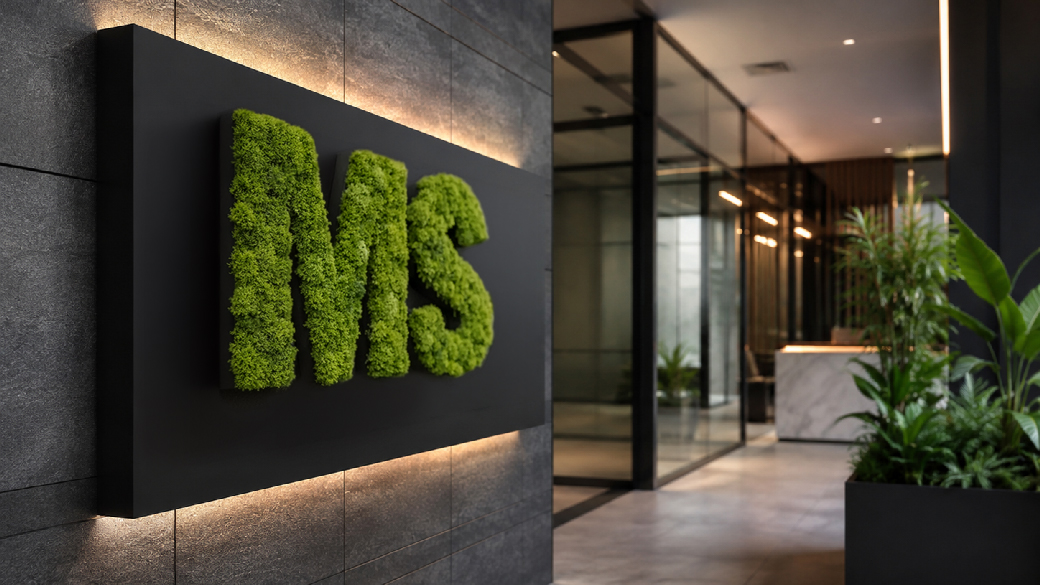
Preserved moss letters create a distinctive natural focal point in a modern business reception area.
Moss letters can give a reception area or business entrance a distinctive, natural character. Unlike conventional company signs made from metal, acrylic or vinyl, preserved moss introduces texture, depth and a softer visual element into modern interiors.
Used for a company name, initials or logo, moss letters and moss logos can become part of the overall interior concept rather than simply functioning as signage. They work particularly well in reception areas, offices, practices, hotels and other commercial spaces where the first impression matters.
Because preserved moss requires neither watering nor daylight, it is also a practical option for many indoor business environments.
Post Contents [hide]
- Why moss letters work so well in business entrances
- How to plan moss letters for your business
- Where moss letters and moss logos work best
- Low maintenance – but designed for suitable indoor spaces
- Creating a complete reception design around a moss logo
- Custom moss letters and moss logos for businesses
- Frequently asked questions about moss letters for businesses
- Natural branding with lasting visual impact
Why moss letters work so well in business entrances
The entrance or reception area is often the first part of a company visitors experience. Its design can therefore influence how professional, welcoming and distinctive a business feels.
Traditional logos made from metal or acrylic create a clean and precise appearance. Moss adds another dimension: its natural surface introduces subtle variations in colour and texture, giving each installation an individual character.
This can be especially effective in different commercial settings. A moss logo can bring a calmer atmosphere to a medical practice, complement a nature-inspired hotel interior or create a warm contrast to glass, concrete and other architectural materials in a contemporary office.
At the same time, preserved moss is comparatively low-maintenance. It does not need water or regular plant care, making it well suited to reception areas where a natural look is desired without the upkeep associated with living plants.
How to plan moss letters for your business
For moss lettering to look balanced and professional, the design should be planned around the room rather than treated as an isolated decorative element. The available wall space, viewing distance, lighting and surrounding materials all influence how the finished installation will appear.
A compact logo may work well behind a reception desk, while larger individual letters can create a stronger visual statement in an entrance hall or conference area. The aim is to make the lettering clearly visible without overwhelming the interior.
Lettering and size
The size of the letters should reflect both the proportions of the wall and the distance from which they will usually be viewed. Large reception areas can support more generous lettering, whereas smaller offices often benefit from a more restrained format.
Simple, clearly defined letter shapes tend to work particularly well with moss because the natural surface already creates visual texture. Very fine lines or extremely intricate details may be less suitable, depending on the type of moss and the scale of the design.
For company branding, proportions are especially important. The lettering should remain recognisable and consistent with the existing corporate identity while still allowing the moss to retain its natural appearance.
Choosing the right type of moss
Different types of preserved moss create different visual effects.
Cushion moss has a soft, three-dimensional structure with rounded natural forms. It creates a particularly tactile and organic appearance and can give larger letters or logos considerable depth.
Reindeer moss, by contrast, has a finer and more branched structure. It is well suited to detailed lettering and can create a lighter, more uniform surface.
The right choice therefore depends on the desired look, the dimensions of the lettering and the surrounding interior. In some designs, different moss structures can also be combined to create additional depth.
Matching the green tone to your brand and interior
Moss lettering does not have to compete with an existing colour concept. Natural green tones can work as a deliberate contrast to neutral interiors in white, grey, black or beige, while also complementing wood, stone and other natural materials.
For businesses with a strong corporate colour palette, the moss can act as a calm natural element while the surrounding wall, lighting or additional logo details provide the connection to the brand.
The result is often most convincing when the moss is integrated into the overall interior rather than treated as a separate decorative feature.
Where moss letters and moss logos work best
Moss lettering can be used in many different commercial interiors. The most suitable placement depends on how prominently the company name or logo should appear and how visitors move through the space.
Common locations include:
- behind the reception desk
- in entrance halls and waiting areas
- on office or conference room walls
- in hotels, restaurants and concept stores
- in medical practices, studios and showrooms
- in meeting areas or customer lounges
A moss logo behind the reception desk is particularly effective because it immediately connects the company identity with the interior design. In larger entrance areas, individual moss letters can also be used as a stronger architectural feature.
The surrounding wall plays an important role as well. Light walls create a fresh contrast with green moss, while darker backgrounds can give the lettering a more dramatic and sophisticated appearance. Wood, concrete or stone surfaces can also work beautifully when the overall design remains visually balanced.
Lighting should ideally highlight the texture of the moss without exposing it to strong direct sunlight. Soft indirect lighting or carefully positioned spotlights can emphasise the three-dimensional surface and make the lettering more noticeable without making the reception area feel overly decorative.
Low maintenance – but designed for suitable indoor spaces
One of the main advantages of preserved moss is that it does not require the care associated with living plants. It does not need watering, fertilising or regular trimming and can therefore be used in areas where conventional greenery would be difficult to maintain.
Even so, preserved moss should be treated as a natural decorative material rather than as an indestructible surface.
For long-lasting results, moss letters should ideally be placed:
- indoors
- away from direct sunlight
- away from strong heat sources
- in rooms without excessive moisture
- where they are protected from frequent touching or mechanical damage
Direct sunlight can cause colours to fade over time, while very dry conditions may make some types of moss feel firmer or more brittle.
This is particularly relevant for business entrances with large windows. If the lettering is installed close to a glazed façade, its position should be chosen carefully so that strong sunlight does not fall directly onto the moss for extended periods.
In a suitable indoor environment, preserved moss provides a practical way to introduce natural texture and greenery without the ongoing maintenance of living plants.
Creating a complete reception design around a moss logo
A moss logo can work especially well when it is integrated into the wider reception concept rather than used as a stand-alone decorative object.
Materials such as wood, stone, metal and glass can create a strong contrast with the soft, organic structure of preserved moss. The combination often feels modern and architectural while still introducing a natural element into the space.
A few design details can make a noticeable difference:
- keep the area around the logo visually calm
- use lighting to emphasise the texture of the moss
- repeat selected materials or colours elsewhere in the reception area
- avoid placing too many decorative elements directly around the lettering
- make sure the scale of the logo suits the wall and reception furniture
If the company already uses strong brand colours, the moss does not necessarily need to reproduce them. A natural green surface can instead act as a neutral visual anchor, while brand colours appear in furniture, signage or smaller accents.
This often creates a more timeless result than trying to make every element of the reception area match exactly.
For larger wall concepts, moss pictures and moss walls can also be combined with lettering to create a more extensive natural feature within an office, hotel, practice or reception area.
Custom moss letters and moss logos for businesses
For commercial interiors, customised moss lettering offers much more flexibility than standard wall decoration. Company names, initials and selected logo shapes can be adapted to the available wall space and the proportions of the room.
The final design should take several factors into account, including letter size, typography, moss type, background material and installation location.
For larger projects, it is particularly important to think about visibility from a distance. A logo that looks well proportioned on a drawing may appear too small once installed in a spacious entrance hall.
A carefully planned moss installation can therefore serve two purposes at the same time: it communicates the company identity and becomes part of the interior architecture.
At Rosemarie Schulz Heidelberg, moss letters and moss designs are created with a focus on natural materials, balanced proportions and an individual finish. This makes it possible to develop solutions that fit both the brand and the surrounding space.
Frequently asked questions about moss letters for businesses
Do moss letters need to be watered?
No. Preserved moss does not need watering, fertilising or regular plant care. Water should actually be avoided, as moisture can damage the preserved material.
Are moss letters made from real moss?
Yes. Preserved moss is natural moss that has been specially treated so that it retains its appearance without continuing to grow. Depending on the design, cushion moss, reindeer moss or a combination of different moss structures can be used.
Are moss letters suitable for outdoor entrances?
Preserved moss is primarily intended for indoor use. Rain, direct sunlight, temperature fluctuations and high humidity can affect both its colour and structure. For this reason, business entrances should only be considered if the moss installation is located inside the building.
How much maintenance does a moss logo require?
Very little. In normal indoor conditions, moss logos do not need routine plant care. They should simply be protected from water, strong sunlight, excessive heat and frequent touching.
Can a company logo be made from moss?
Many company names, initials and logo elements can be interpreted using preserved moss. The feasibility depends on the shape, level of detail and required dimensions. Clear forms and sufficiently generous proportions usually produce the best results.
Which moss is best for lettering?
That depends on the desired appearance. Cushion moss creates a fuller, more three-dimensional surface, while reindeer moss has a finer structure that can work particularly well for detailed lettering. The size and shape of the design should always be considered when choosing the moss.
Where should moss letters be placed in an office?
Reception walls, entrance areas, waiting rooms, conference zones and customer lounges are particularly suitable. The best position is one where the lettering is clearly visible but protected from strong direct sunlight and frequent contact.
Natural branding with lasting visual impact
Moss letters combine company branding with a natural decorative element. They can soften modern interiors, create an inviting first impression and give reception areas a more individual identity without introducing the maintenance requirements of living plants.
Whether used for a company name, individual initials or a moss logo, the most convincing results come from careful planning: the proportions, type of moss, background, lighting and surrounding materials should all work together.
For businesses looking for an alternative to conventional wall signage, preserved moss offers a distinctive way to bring nature, texture and brand identity into the interior.


