
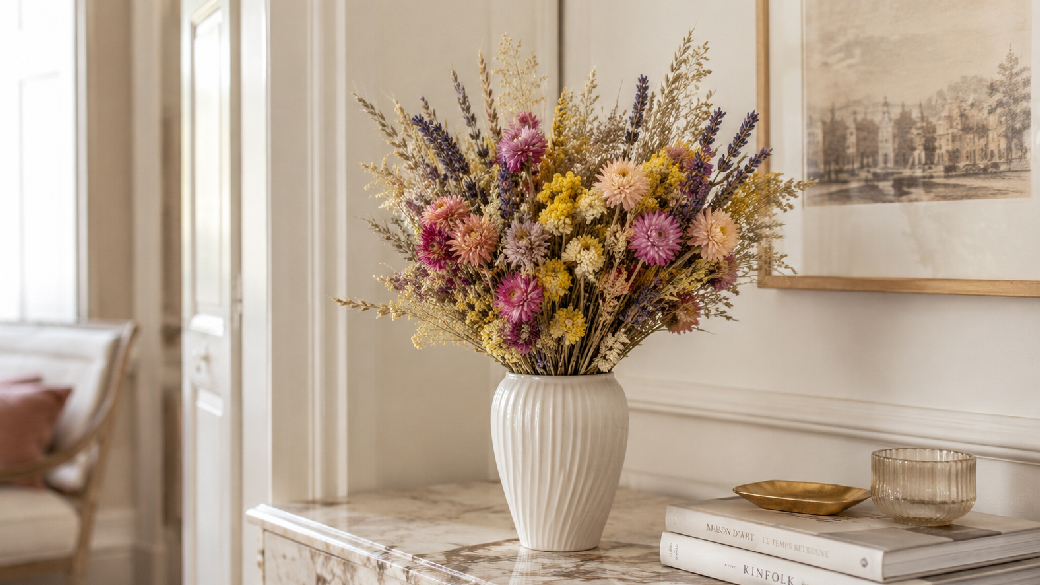
Looking for the perfect dried flower bouquet? Discover how to choose the right colours, size and style for your home and create long-lasting natural decoration.
Dried flowers have become much more than a seasonal decorating trend. With their natural textures, soft colours and distinctive shapes, they bring warmth and character into a room – while remaining beautiful for a long time without the need for water.
From delicate lavender and airy grasses to colourful strawflowers and natural wheat stems, there are countless ways to create a dried flower arrangement that complements your home.
But which dried flowers are right for your interior? Which colours work well together, what size should you choose and which bouquet suits which style of décor?
In this guide, we show you what to look for when buying dried flowers and how to choose an arrangement that fits naturally into your home.
Post Contents [hide]
- Buying Dried Flowers: What Should You Look For?
- Choosing the Right Colour Palette for Your Home
- Choosing the Right Size for Your Vase and Room
- Dried Flowers as a Long-Lasting Gift
- Which Dried Flowers Suit Your Interior Style?
- Dried Flowers for Table Decorations and Special Occasions
- How to Keep Dried Flowers Looking Beautiful
- Dried Flowers or Preserved Flowers?
- Choosing Dried Flowers with Character
- Frequently Asked Questions About Buying Dried Flowers
Buying Dried Flowers: What Should You Look For?
The most beautiful dried flower arrangements are those that suit their surroundings, your personal interior style and the occasion.
A generous bouquet in natural tones can become a calm focal point in a living room or on a wide sideboard. For a narrow console table, bedside table or dining table, a smaller arrangement is often the more harmonious choice. Even a few individual dried stems can make a striking statement when the proportions of the flowers and vase are carefully balanced.
It is also worth looking closely at the different textures and structures when choosing dried flowers.
Dried grasses have a light, natural appearance and bring movement to an arrangement. Lavender adds a subtle Mediterranean character, while strawflowers create more pronounced accents with their firm, papery petals.
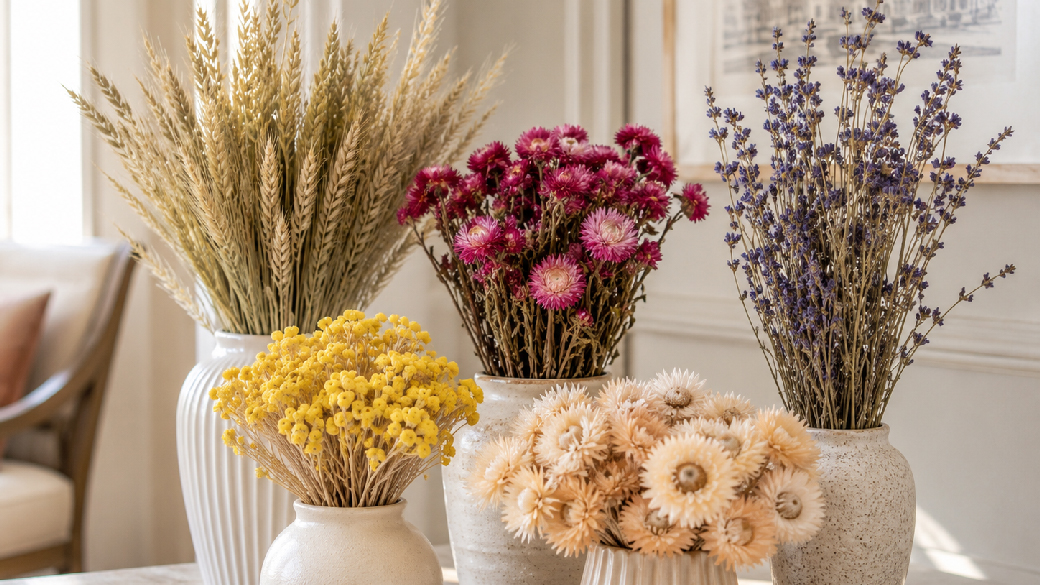
Everlasting flowers, also known as immortelles, have small, compact flower heads and work particularly well when a bouquet needs a little more colour and structure. Barley, wheat and oat stems, meanwhile, add height and movement while maintaining a warm, understated and natural appearance.
A well-composed dried flower bouquet combines different textures without appearing overly busy. Rather than filling an arrangement with as many similar flowers as possible, a carefully selected mixture of flowers, grasses and stems creates depth, balance and individual character.
The result is a bouquet that does not simply fill a vase, but becomes part of the room itself.
Choosing the Right Colour Palette for Your Home
Colour plays an important role in how a dried flower arrangement feels within a room. A bouquet does not necessarily need to combine many different shades. In fact, a clearly defined colour palette can often look more refined, balanced and harmonious.
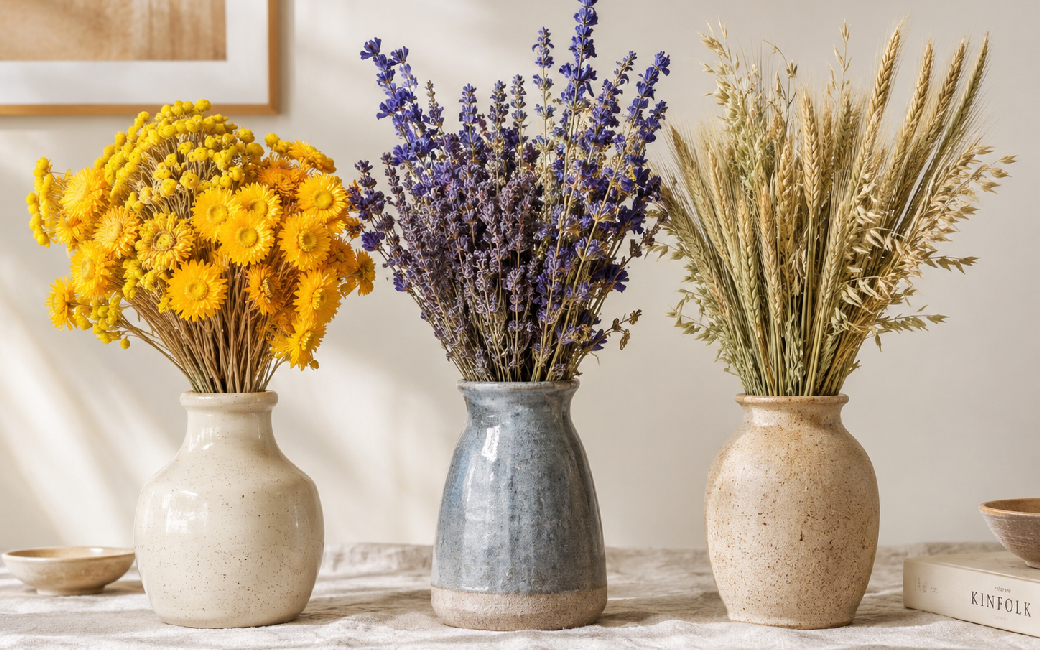
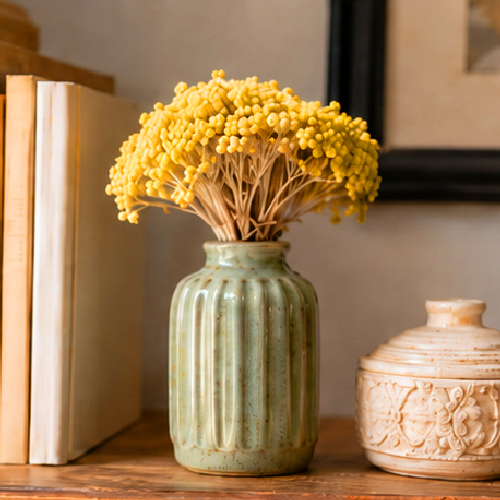
Yellow immortelles and strawflowers have a cheerful, sunny character. They are ideal for adding warmth and a gentle splash of colour to a neutral interior. Paired with a light ceramic vase, yellow dried flowers can feel fresh and contemporary without becoming too dominant.
Lavender and blue delphinium bring a calmer, more elegant atmosphere into the home. Shades of blue and violet work particularly well with white, grey, stone or sand-coloured vases and can complement both traditional and modern interiors.
Dried barley, wheat and oat stems are appealing because of their naturally understated colours. Their soft green, beige and golden tones pair beautifully with wood, linen, ceramics and other natural materials. They create a warm, relaxed look and can be combined with many different decorating styles.
If you are choosing a dried flower bouquet as a gift, the recipient's interior can also provide useful inspiration. Selecting colours that already appear in their home creates a harmonious result, while a deliberately contrasting shade can turn the bouquet into a decorative focal point.
Natural, Bleached or Dyed Dried Flowers?
Dried flowers are available in a wide range of finishes, and each creates a different visual effect.
Natural dried flowers are characterised by their organic, understated appearance. Their colours and shapes are not always perfectly uniform – and that is part of their appeal. Small variations highlight the natural character of the material and help make every arrangement unique.
Bleached dried flowers have a lighter, softer and often more contemporary look. Their pale tones work particularly well in minimalist interiors, Scandinavian-inspired spaces and elegant wedding decorations.
Dyed dried flowers offer even more possibilities when you want to introduce a specific colour into a room or table setting. Soft blush tones can feel romantic and delicate, while deeper berry shades or an intense blue can create a more dramatic and sophisticated accent.
Whatever finish you choose, quality matters. Colour should enhance the natural structure of the flower or stem rather than completely disguise it.
Minor variations in shade, shape and texture are normal with natural materials. Rather than being imperfections, they are part of what gives dried flowers their individual character.
Choosing the Right Size for Your Vase and Room
Sometimes a dried flower bouquet loses its impact not because of the flowers themselves, but because the vase is the wrong size or shape.
A generous, full arrangement needs a stable vase with enough weight and a sufficiently wide opening. This gives the stems room to spread naturally while ensuring that the vase remains balanced.
For slender grasses, lavender or just a few distinctive stems, a tall, narrow vase is usually the better choice. It keeps the stems together and emphasises their elegant, upright silhouette.
Small, compact arrangements work particularly well in lower vases or shallow containers. They are ideal for bedside tables, smaller side tables, shelves or narrow surfaces where a large bouquet might feel overwhelming.
As a general guideline, a dried flower bouquet can be around one and a half times the height of the vase. This is not a strict rule, however. In a spacious room with high ceilings or on a wide sideboard, a larger and more expansive arrangement can create a beautiful focal point.
For a dining table, the proportions should be considered differently. The flowers should not obstruct the view between people sitting opposite one another. Low arrangements or several smaller vases placed along the table create a decorative effect while leaving enough space for conversation, plates and glasses.
The right combination of bouquet and vase makes a significant difference. Rather than choosing the flowers first and finding any available vase afterwards, it is often worth considering both together.
Dried Flowers as a Long-Lasting Gift
A carefully arranged dried flower bouquet is a thoughtful gift for many occasions – from birthdays and housewarmings to anniversaries, Mother's Day or simply as a small gesture of appreciation.
Unlike fresh flowers, dried flowers do not need to be placed in water immediately. This makes them particularly easy to give and allows the recipient to enjoy the arrangement for much longer.
Smaller, ready-arranged bouquets are especially practical because they can be displayed with very little effort. Pairing the flowers with a suitable vase can turn them into a complete decorative gift that does not need to be rearranged at home.
Colour can also add a personal message to the bouquet.
Yellow flowers convey warmth, joy and optimism, while lavender has a calm, elegant and slightly Mediterranean character. Natural wheat, barley or oat stems create a softer, understated impression and are particularly suitable for interiors with warm neutral tones and natural materials.
When choosing dried flowers as a gift, it is therefore worth considering not only the occasion but also the recipient's home and personal style.
A bouquet that complements its surroundings can become more than a decorative accessory. It can serve as a lasting reminder of a birthday, a new home or another special moment.
Which Dried Flowers Suit Your Interior Style?
Dried flowers can complement almost any interior. The key is to combine the right flowers, colours and vase with the character of the room.
A bouquet that looks beautifully at home in a warm, natural interior may feel very different in a minimalist setting. Rather than following a single decorating rule, it is therefore worth choosing dried flowers that reflect the materials, colours and atmosphere already present in your home.
Natural and Warm
For a warm, relaxed interior, dried oats, barley and wheat are particularly suitable. Their soft beige, green and golden tones blend naturally with wood, linen, stone and handmade ceramics.
Arranged loosely in a ceramic vase or placed on a wooden sideboard, these simple stems create a calm and inviting atmosphere without appearing overly decorative.
Natural materials work especially well when the arrangement is allowed to remain slightly irregular. Small differences in height, colour and shape reinforce the organic character of the flowers.
Romantic and Soft
For a softer and more romantic look, combine gypsophila, delicate lavender and strawflowers in cream, blush pink or pale lilac tones.
Light glass vases, softly coloured ceramics and understated accessories complement this style particularly well. The overall effect should remain light and airy rather than overly elaborate.
A few carefully chosen flowers are often enough to create a gentle, elegant arrangement for a bedroom, dressing table or softly styled living space.
Modern and Minimalist
In a modern interior, less is often more.
A small number of distinctive lavender stems, individual dried grasses or a monochrome group of immortelles can create a strong decorative statement when arranged in a sculptural vase.
Neutral shades such as white, beige and natural straw tones work especially well, while one carefully chosen accent colour can add contrast without disturbing the calm aesthetic.
For minimalist spaces, the silhouette of the arrangement is just as important as the flowers themselves. Clear lines and generous empty space allow each stem to become part of the composition.
Mediterranean and French-Inspired
Lavender is perhaps the most characteristic dried flower for a Mediterranean or southern French-inspired interior.
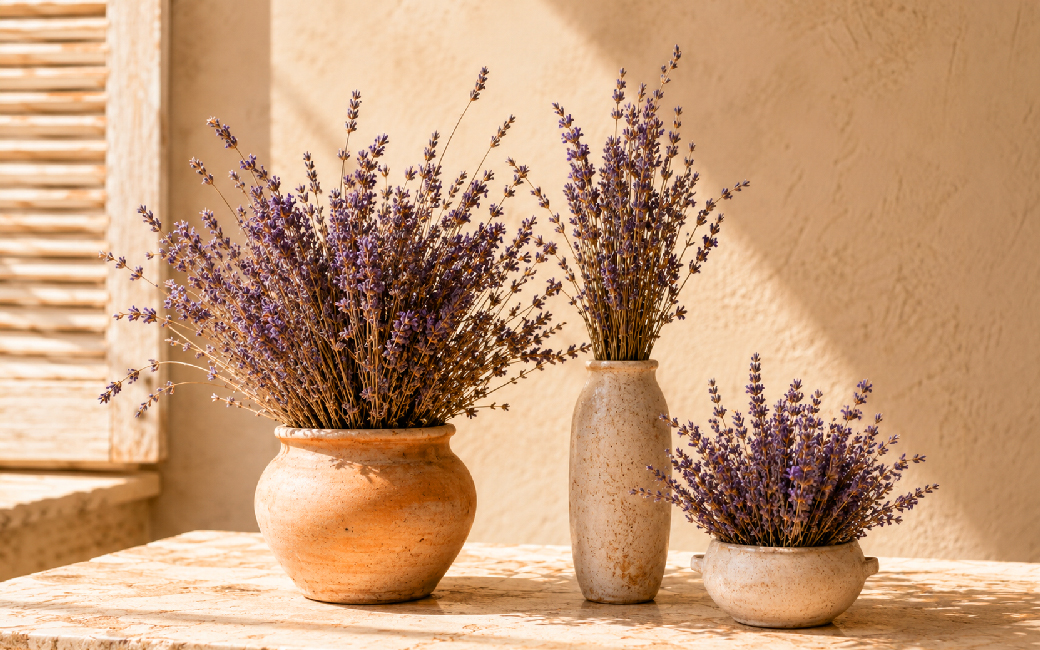
Loosely arranged in a ceramic or terracotta vase, dried lavender immediately brings to mind the landscapes and relaxed atmosphere of Provence.
Natural stone, warm sand tones, gently aged wood and linen textiles complement this look beautifully. The bouquet does not need to be perfectly symmetrical. In fact, a slightly informal and irregular arrangement often feels more authentic.
For a more refined interpretation, combine lavender with a simple cream or stone-coloured vase and keep the surrounding decoration understated.
Seasonal and Atmospheric
Dried flowers are also ideal for changing the atmosphere of a room throughout the year.
In autumn, dried wheat, barley and strawflowers in warm yellow, gold and brown tones create a cosy and inviting mood. Their natural textures work particularly well with candles, wood and heavier textiles.
For Christmas and winter decorations, deeper shades, subtle golden accents, pine cones and decorative branches can be added to create a more festive arrangement.
In spring, pale colours and airy flowers introduce a lighter, fresher feeling into the home. Soft pink, cream, lilac and natural green tones can brighten a room without relying on fresh flowers that begin to fade after only a few days.
This flexibility is one of the great advantages of dried flowers: the same basic materials can be styled in very different ways depending on the season, the vase and their surroundings.
Dried Flowers for Table Decorations and Special Occasions
Dried flowers are particularly versatile when used as table decorations. Because they do not require water, they can be arranged in places and containers that would be less practical for fresh flowers.
For a dining table, several small vases often work better than one large bouquet. They create a decorative rhythm across the table while keeping the arrangement low enough for guests to see and talk to one another comfortably.
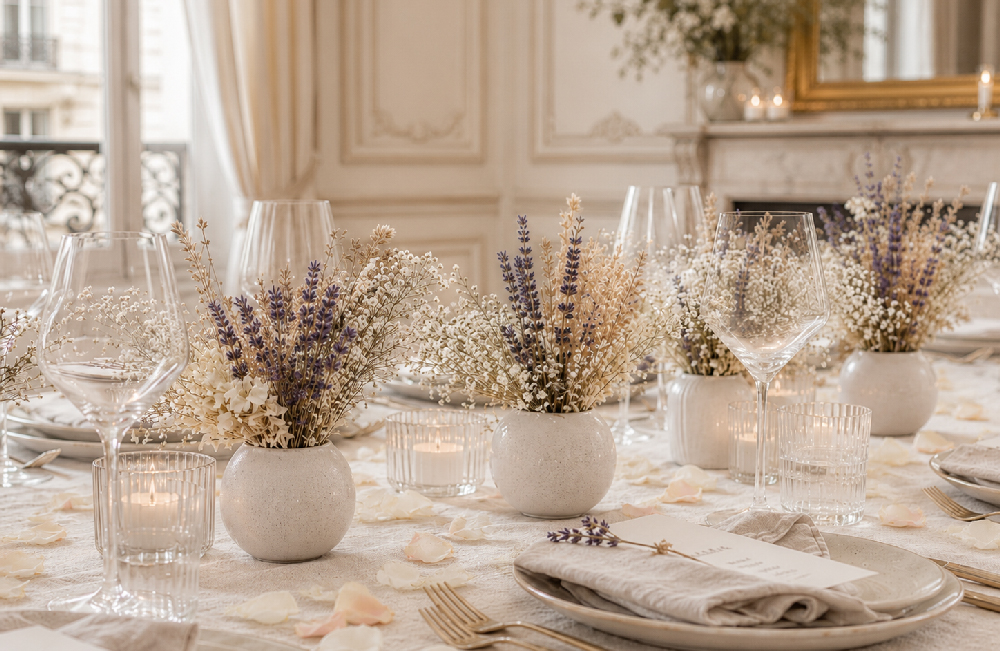
A combination of dried grasses, delicate flowers and individual seed heads can create an elegant but relaxed table setting. Natural shades work particularly well with linen, wood and ceramics, while coloured dried flowers can be used to coordinate the decoration with a particular occasion.
For birthdays, soft pink, yellow or colourful accents can make the table feel cheerful and welcoming.
For weddings, pale beige, cream, blush and lavender tones create a softer and more romantic atmosphere. Dried flowers are also practical for wedding decorations because arrangements can be prepared in advance and do not need to remain in water throughout the day.
During autumn, warm golden shades, dried wheat and strawflowers complement seasonal table settings beautifully. In winter, branches, cones or subtle metallic details can be added for a more festive look.
Another advantage is that the arrangements can be reused. After a celebration, small dried flower bouquets can be moved to a sideboard, shelf or bedside table rather than being discarded after only a few days.
This makes dried flowers an attractive choice when you want decorations that can continue to be enjoyed long after the occasion itself.
How to Keep Dried Flowers Looking Beautiful
One of the main advantages of dried flowers is that they require very little care. However, a few simple precautions will help preserve their colour, shape and delicate structure for as long as possible.
Most importantly:
Do not place dried flowers in water.
They should always remain completely dry. Moisture can soften the plant material, cause deformation and, in unfavourable conditions, encourage mould.
It is also best to avoid locations with high humidity, such as directly beside a shower, bath or frequently opened kitchen window where condensation may occur.
Keep Them Away from Strong Sunlight
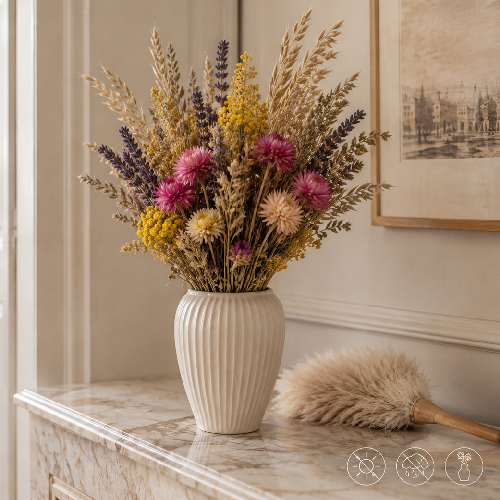
Direct sunlight can gradually fade natural as well as dyed dried flowers.
A bright room is usually not a problem, but prolonged exposure to strong sunlight – particularly on a windowsill – can cause colours to become noticeably paler over time.
A protected position on a sideboard, shelf, console table or dining table is therefore generally the better choice.
Remove Dust Gently
Over time, a little dust may settle on the flowers.
Because many dried petals and stems are fragile, they should not be wiped with a damp cloth. Instead, dust can be removed carefully with a soft brush or with a very gentle stream of cool air from a distance.
Avoid bending or repeatedly rearranging delicate stems unnecessarily, as dried plant material can become brittle.
Choose the Right Location
A suitable location has a significant influence on how long a dried flower bouquet remains attractive.
Ideally, dried flowers should be kept:
- indoors,
- in a dry environment,
- away from direct sunlight,
- away from strong heat sources,
- and protected from frequent handling.
With the right placement, dried flowers can remain decorative for a long time and require considerably less attention than a fresh bouquet.
Dried Flowers or Preserved Flowers?
Both dried flowers and preserved flowers offer a long-lasting alternative to a fresh bouquet, but their appearance and decorative character are quite different.
Dried flowers have a naturally matt finish and are defined by their varied textures, delicate structures and often slightly seasonal character. Grasses, wheat, strawflowers, lavender and other dried botanicals are particularly well suited to relaxed vase arrangements, wreaths, table decorations and loosely arranged bouquets.
Preserved flowers and Infinity Roses, by contrast, retain a softer and more fresh-looking appearance. Preserved roses, for example, keep much of the velvety texture and elegant shape associated with a freshly cut rose, even though they no longer require water.
This makes the two types of flowers suitable for different purposes.
If you are looking for an airy, natural arrangement for a vase or want to introduce texture and organic materials into your interior, dried flowers are often the better choice.
If the flower itself is intended to become the focal point – particularly for a romantic gift, anniversary or special keepsake – preserved roses can create a more refined and luxurious impression. An elegant Infinity Rose Box, for example, combines preserved roses with a ready-to-give presentation.
There is no need to choose one over the other in every situation. Dried and preserved flowers can each play a different role in the home, depending on the atmosphere you want to create.
Choosing Dried Flowers with Character
At Rosemarie Schulz in Heidelberg, we see floral decoration as more than a short-lived finishing touch. Flowers, colours and natural materials can give a room personality and help preserve the memory of special moments.
That is why choosing dried flowers should not be based on colour alone.
Consider the place where the bouquet will be displayed, the proportions of the vase, the surrounding materials and the overall character of the room. A carefully chosen arrangement should feel as though it belongs there.
A beautiful dried flower bouquet does not need to be large or extravagant to attract attention. Often, just a few well-balanced flowers, grasses and stems are enough to transform a space.
Allow the arrangement enough room to show its shape and natural structure. In the right setting, dried flowers can become a lasting part of your interior rather than simply a temporary decoration.
Discover dried flowers at Rosemarie Schulz and find an arrangement that suits your home, your style and the occasion.
Frequently Asked Questions About Buying Dried Flowers
What should I look for when buying dried flowers?
Look for dried flowers with attractive natural shapes, intact stems and colours that suit your interior. It is also worth considering the size of the bouquet, the vase you plan to use and whether you prefer natural, bleached or dyed flowers. A balanced mixture of flowers, grasses and stems usually creates a more interesting and harmonious arrangement.
How long do dried flowers last?
Dried flowers can remain decorative for many months and often considerably longer when kept in suitable conditions. Their exact lifespan depends on the type of flower, the location and the amount of sunlight, humidity and handling they are exposed to. Over time, some fading or increased brittleness is natural.
Do dried flowers need water?
No. Dried flowers should never be placed in water. Moisture can soften the dried plant material, affect its shape and increase the risk of mould. They are intended to be displayed completely dry.
Which vase is best for dried flowers?
The best vase depends on the size and shape of the arrangement. Tall, narrow vases work well for grasses, lavender and individual stems, while fuller bouquets usually need a heavier vase with a wider opening. As a general guideline, the bouquet can be around one and a half times the height of the vase.
Where is the best place to display dried flowers?
Choose a dry indoor location away from direct sunlight, excessive humidity and strong heat sources. Sideboards, shelves, console tables and dining tables are often good locations. Avoid sunny windowsills if you want the colours to remain attractive for as long as possible.
What is the difference between dried flowers and preserved flowers?
Dried flowers are naturally dehydrated and usually have a more matt, textured and organic appearance. Preserved flowers are treated to retain more of their original softness, shape and fresh-looking character. Preserved roses, for example, often retain a velvety appearance, while dried flowers are particularly valued for their natural structures and decorative textures.


