
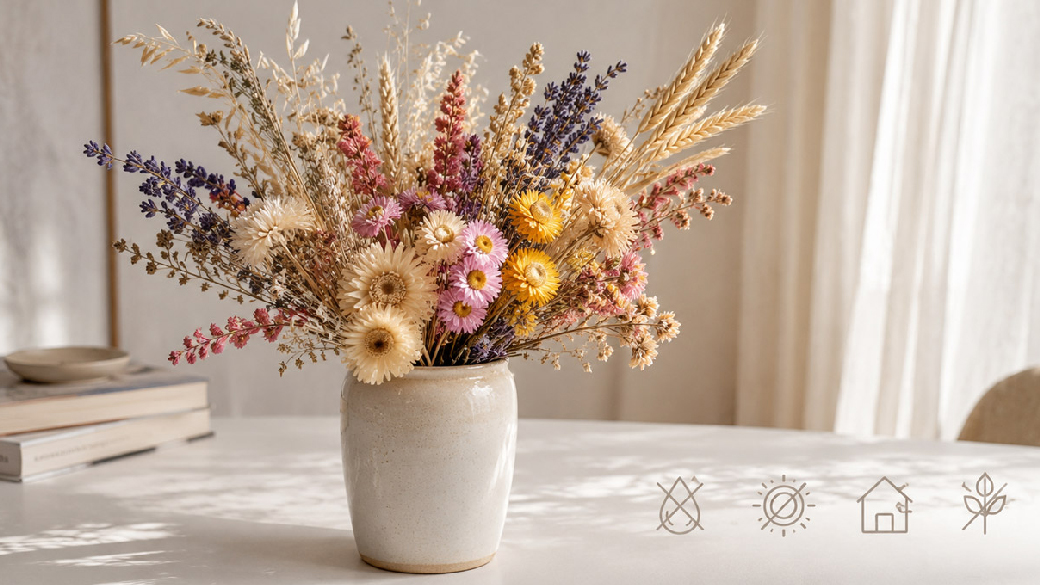
Keep dried flowers dry, protect them from direct sunlight and display them indoors to preserve their beauty for longer.
Dried flowers bring a natural, warm and timeless feel to the home. Whether arranged as a dried flower bouquet in a vase, used in a wreath, styled as table decoration or displayed as individual stems, they are a beautiful alternative to fresh cut flowers.
One of their greatest advantages is that dried flowers require very little maintenance. They do not need watering and, when cared for properly, many varieties can remain decorative for months or even years.
However, dried flowers are not completely maintenance-free. Sunlight, moisture, dust and frequent handling can all affect their colour, shape and longevity.
In this guide, we explain how to care for dried flowers, where to display them and which common mistakes to avoid.
Post Contents [hide]
- What are dried flowers?
- The golden rule: dried flowers need no water
- Where should you keep dried flowers?
- Keep dried flowers away from direct sunlight
- Protect dried flowers from moisture and humidity
- How to clean and dust dried flowers
- Handle dried flowers as little as possible
- Should you spray dried flowers?
- How long do dried flowers last?
- How to care for strawflowers and immortelles
- How to style dried flowers in a vase
- How to store dried flowers
- Common dried flower care mistakes
- Dried flowers are low-maintenance – but not maintenance-free
- Discover dried flowers for natural interior decoration
- FAQ – How to care for dried flowers
What are dried flowers?
Dried flowers are real flowers, grasses or other plant materials that have had most of their natural moisture removed after harvesting.
Drying helps preserve their shape and allows them to be used as natural decoration for much longer than fresh flowers.
Popular dried flowers and grasses include:
- strawflowers and immortelles
- Lagurus, also known as bunny tails
- pampas grass
- baby's breath
- statice
- eucalyptus
- dried roses
- lavender
- dried grasses and seed heads
Dried flowers are available in many different forms, from individual stems and loose bunches to bouquets, wreaths and ready-made arrangements.
Some dried flowers are naturally more delicate than others. Fine petals and small leaves can become brittle, while grasses and strawflowers tend to be more robust.
The correct care therefore depends partly on the type of dried flower, but a few basic principles apply to almost all dried arrangements.
How to store dried flowers
The golden rule: dried flowers need no water
The most important rule of dried flower care is simple:
Never put dried flowers in water.
Unlike fresh cut flowers, dried flowers cannot absorb water to stay fresh. Moisture can actually damage them.
Water may cause stems to soften, flowers to lose their shape or, in the worst case, mould to develop.
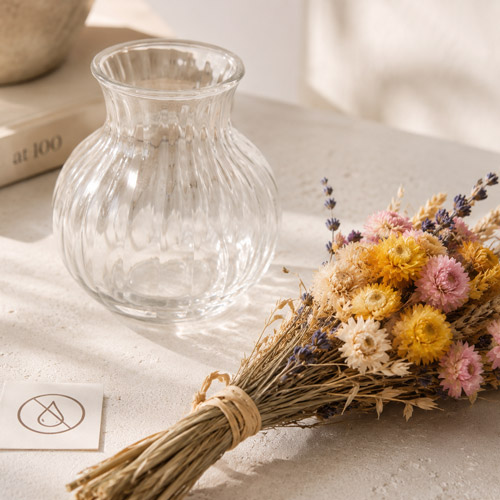
If you display dried flowers in a vase, always make sure that the vase is completely dry before arranging them.
Even a small amount of residual water at the bottom of a vase should be avoided.
A narrow vase is often particularly suitable because it supports the stems without requiring water and helps the arrangement retain its shape.
The same principle also applies to many preserved flowers, including Infinity Roses: they should remain dry and should not come into contact with water. If you would like to understand how preserved flowers differ from traditionally dried flowers, our guide to preserved roses and Infinity Roses explains the preservation process in more detail.
The golden rule: dried flowers need no wate
Where should you keep dried flowers?
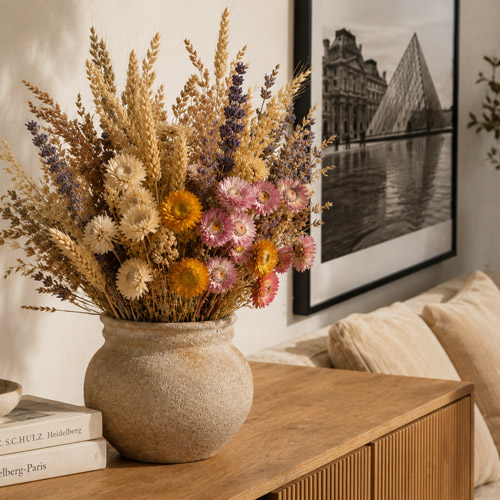
Dried flowers prefer a dry and protected indoor location.
A room with normal indoor temperatures and no excessive humidity is usually ideal.
Suitable places include:
- living rooms
- bedrooms
- hallways
- dining rooms
- shelves
- sideboards and console tables
- desks
- dining tables
- decorative displays
They can work particularly well in places where fresh flowers may be inconvenient because there is no need to change water or regularly replace the arrangement.
However, not every location in the home is equally suitable.
Keep dried flowers away from direct sunlight
A bright room is perfectly suitable for dried flowers, but strong direct sunlight should be avoided.
Prolonged exposure to sunlight can gradually fade the natural or dyed colours of dried flowers.
This is particularly noticeable with strongly coloured flowers, which may lose some of their intensity over time.
A dried bouquet therefore does not need to be kept in a dark room. The better choice is a bright location with indirect daylight.
Try to avoid placing dried flowers directly in front of a south-facing window or behind glass where intense sunlight reaches the flowers for several hours each day.
This helps preserve their colour for longer.
Protect dried flowers from moisture and humidity
Moisture is one of the greatest enemies of dried flowers.
Because the natural water content has been removed during drying, the flowers should remain in a dry environment afterwards.
Very humid rooms can cause petals, leaves and grasses to change shape. Persistent moisture may also encourage mould.
Locations that are generally less suitable include:
- bathrooms
- very humid areas of the kitchen
- laundry rooms
- conservatories with regular condensation
- damp window sills
- areas directly beside a humidifier
- outdoor spaces
Dried flowers are primarily intended for indoor decoration.
Using them outside is generally not recommended. Rain, humidity, wind and strong sunlight can quickly damage delicate dried plant material.
How to clean and dust dried flowers
Over time, dust can settle on dried flowers just as it does on any other decorative object.
Cleaning them requires a little more care because dried petals and leaves can be fragile.
Avoid wiping dried flowers with a damp cloth.
Instead, try one of the following methods:
- use a very soft feather duster
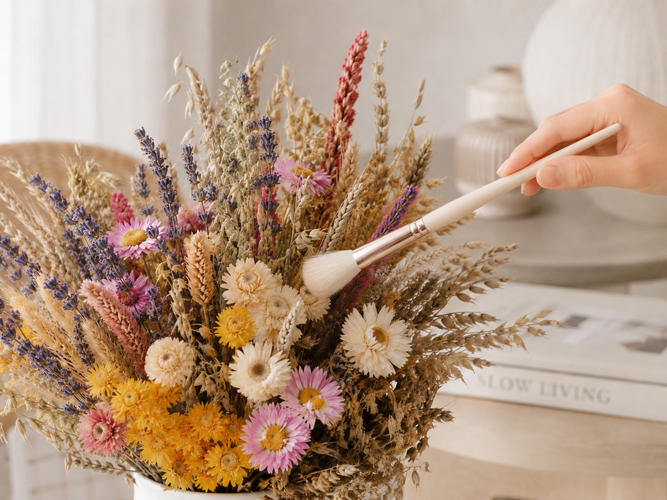
- gently brush individual flowers with a fine, soft brush
- carefully shake the arrangement outdoors
- use a hairdryer on a cool, low setting from a safe distance
Whichever method you choose, avoid rubbing, squeezing or pressing the flowers.
Small petals, leaves and delicate grasses can break easily once dried.
For intricate arrangements, using a small soft brush can be particularly useful because it allows you to remove dust from individual areas without disturbing the entire bouquet.
Handle dried flowers as little as possible
Dried flowers can look surprisingly sturdy, but the drying process makes many plant materials more brittle than they were when fresh.
If you need to move or rearrange a dried bouquet, hold the flowers gently by the stems rather than by the flower heads.
This is particularly important for delicate petals and fine grasses.
Wreaths and wall decorations should also be moved as little as possible once they are in place.
The less the arrangement is handled, the better its structure is likely to remain.
Should you spray dried flowers?
Dried flowers should generally not be sprayed with water.
Fragrance sprays, household cleaning sprays and other liquids can also cause staining or alter the natural texture of the flowers.
For delicate, naturally dried or dyed flowers, it is usually best to avoid sprays altogether.
You may occasionally see advice suggesting hairspray as a way of stabilising certain dried grasses. While this may work for some robust materials, it is not suitable for every type of dried flower and can change the appearance or surface of delicate petals.
For most decorative dried flowers, the safest approach is simple:
Keep them dry and leave them as natural as possible.
How long do dried flowers last?
There is no single lifespan that applies to every dried flower.
How long dried flowers remain attractive depends on several factors, including:
- the type of flower or grass
- how it was dried
- whether it has been dyed
- the amount of sunlight it receives
- humidity
- how often it is handled
- how it is stored
Many dried flowers can remain decorative for several months to several years when kept in suitable conditions.
To help them last as long as possible:
- keep them dry
- avoid direct sunlight
- never place them in water
- handle them as little as possible
- protect them from excessive dust
- keep them away from high humidity
Even with good care, dried flowers will naturally change over time.
Colours may gradually become softer and individual stems or petals may develop a more aged appearance.
This is part of the natural character of dried flowers rather than necessarily a sign that anything is wrong.
How to care for strawflowers and immortelles
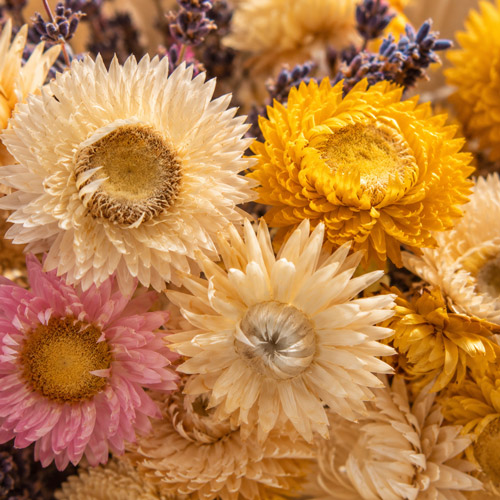
Strawflowers – often associated with immortelles or Helichrysum – are particularly popular for dried flower arrangements because they retain their shape and colour remarkably well.
Their distinctive papery petals make them naturally suited to drying.
Despite their robust appearance, the same care rules still apply:
- do not water them
- keep them dry
- avoid prolonged direct sunlight
- dust them carefully
- avoid repeatedly touching or pressing the flowers
Strawflowers and immortelles are particularly attractive in dried bouquets, wreaths, table arrangements and seasonal decorations.
Their colours and sculptural flower heads also make them easy to combine with grasses, eucalyptus and other natural materials.
How to style dried flowers in a vase
One of the simplest ways to decorate with dried flowers is to arrange them in a vase.
Ceramic, glass and metal vases can all work beautifully, as can simple jugs and decorative vessels.
The only essential rule is that the container must be completely dry.
You can create more natural-looking arrangements by combining stems of different heights.
Tall grasses add movement and lightness, while compact flower heads provide colour and structure.
Attractive combinations include:
- immortelles with eucalyptus
- pampas grass with Lagurus
- lavender with baby's breath
- dried wheat with natural grasses
- beige, cream and neutral dried flowers
- colourful dried flowers as a table accent
You do not necessarily need a large bouquet. A few carefully selected stems in a simple vase can create a particularly elegant and contemporary look.
How to store dried flowers
Dried flowers can also be stored and brought out again for seasonal decoration.
This can be useful for arrangements used for weddings, autumn displays, Christmas decorations or other special occasions.
For storage, choose a place that is:
- dry
- dark
- protected from dust
- protected from pressure
- free from major temperature fluctuations
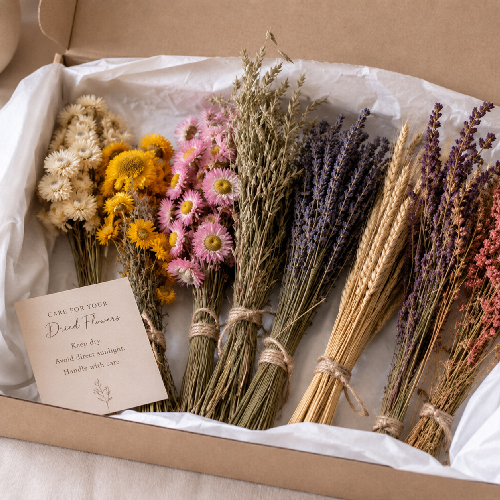
Loosely wrapping the flowers in tissue paper or clean paper can provide additional protection.
They can then be placed carefully inside a cardboard box.
Avoid packing the flowers too tightly, as pressure can crush petals and bend stems.
Plastic bags are not always ideal, particularly if there is any possibility of moisture becoming trapped inside.
A clean, dry cardboard box stored in a dry room is often the simpler option.
Common dried flower care mistakes
| Care mistake | Why it can be a problem |
|---|---|
| Water in the vase | Moisture can soften stems and encourage mould. |
| Direct sunlight | Colours may fade more quickly. |
| Keeping them in a bathroom | High humidity can damage dried plant material. |
| Frequent handling | Delicate petals, leaves and grasses can break. |
| Cleaning with a damp cloth | Moisture can cause staining and deformation. |
| Packing them too tightly | Flowers and stems can become crushed or bent. |
| Displaying them outdoors | Rain, wind, humidity and strong sunlight can quickly cause damage. |
Following a few simple rules is usually enough to avoid these problems.
Dried flowers are low-maintenance – but not maintenance-free
Dried flowers are a wonderful choice for anyone who enjoys natural decoration without having to regularly replace fresh cut flowers.
They need no water and very little ongoing maintenance, yet they can remain attractive for a long time when displayed in the right conditions.
The essential dried flower care tips are easy to remember:
Keep them dry, protect them from direct sunlight, remove dust carefully and handle them as little as possible.
With these simple precautions, dried bouquets, strawflowers, grasses, wreaths and other dried arrangements can retain their distinctive natural beauty for months or even years.
If you prefer flowers that retain a softer, more fresh-looking appearance, preserved Infinity Roses offer another long-lasting alternative for indoor decoration.
If you enjoy long-lasting floral decoration but prefer an even more robust and flexible option, artificial flowers can also be an attractive choice for vases and decorative arrangements.
Discover dried flowers for natural interior decoration
From colourful immortelles and fragrant dried lavender to natural bouquets and materials for wreaths and arrangements, dried flowers offer countless possibilities for decorating your home.
At Rosemarie Schulz, we select dried flowers and natural materials for stylish indoor arrangements – whether you prefer subtle natural shades or colourful floral accents.
FAQ – How to care for dried flowers
Do dried flowers need water?
No. Dried flowers should never be watered or placed in water. Always display them in a completely dry vase or container.
Can you keep dried flowers in the bathroom?
It is generally better not to. Bathrooms often have high humidity, which can damage dried flowers and, in some cases, encourage mould.
How do you remove dust from dried flowers?
Use a soft brush, feather duster or a hairdryer on a cool, low setting from a safe distance. Avoid damp cloths and do not rub delicate petals.
Can dried flowers be kept in sunlight?
Bright indirect light is fine, but strong direct sunlight should be avoided because it can cause colours to fade more quickly.
How long do dried flowers last?
Depending on the plant, drying method and location, dried flowers can remain decorative for several months to several years.
Can dried flowers be used outdoors?
Dried flowers are mainly intended for indoor decoration. Rain, humidity, wind and strong sunlight can damage them quickly outdoors.
Why do small pieces sometimes fall off dried flowers?
This is normal with natural dried materials. Flowers, leaves and grasses become more fragile during the drying process, so small pieces may occasionally break off when the arrangement is moved or transported.
Can you use hairspray on dried flowers?
Hairspray is sometimes used on certain robust dried grasses, but it is not suitable for every dried flower. It may alter delicate or dyed flowers, so in most cases it is better to keep dried flowers dry and avoid additional sprays.


