
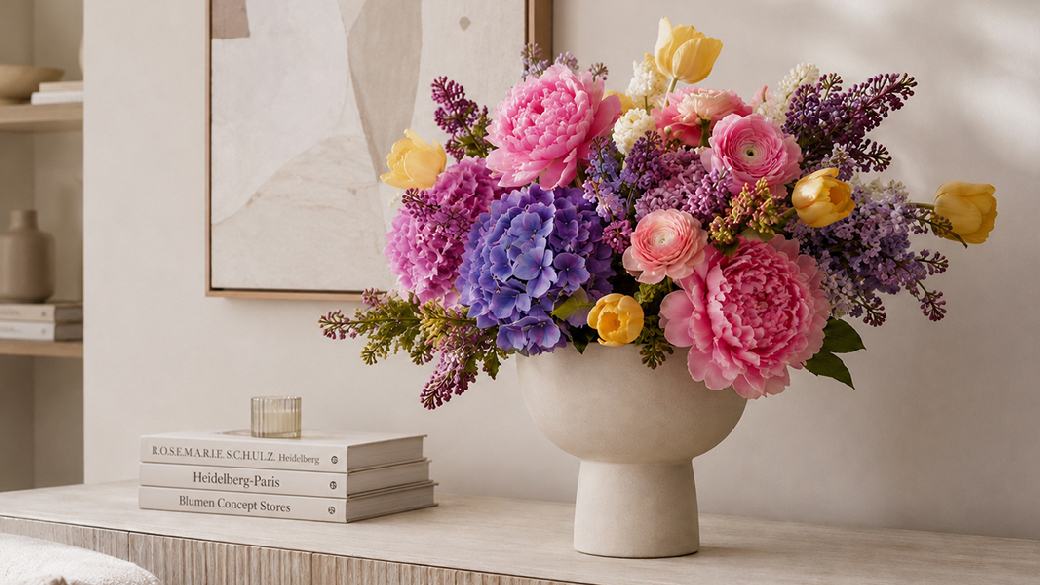
Artificial flowers bring lasting colour and floral character to modern interiors.
Why decorate with artificial flowers?
Artificial flowers have become much more realistic in recent years. Carefully made petals, natural-looking colour variations and detailed leaves mean that high-quality artificial flowers can blend beautifully into modern interiors.
They are particularly practical if you want floral decoration that stays attractive for a long time. Unlike fresh flowers, artificial flowers do not wilt and can be rearranged whenever you want to create a new look.
They are also a useful choice for places where fresh flowers are less practical, such as:
- shelves and bookcases
- entrance areas
- sideboards and consoles
- guest rooms
- offices and reception areas
- rooms with little natural light
Another advantage is their versatility. Individual stems can be combined again and again, allowing you to adapt an arrangement to the season, your interior style or a new colour scheme.
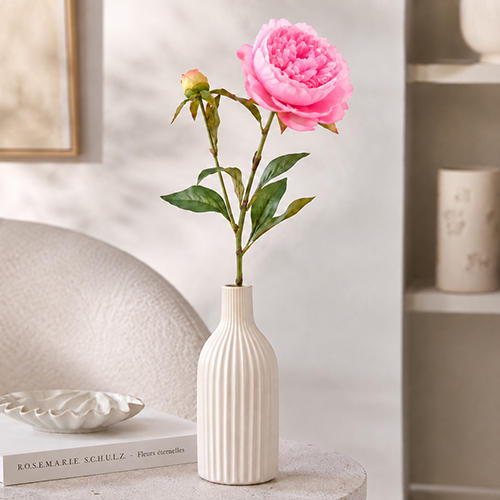
How to arrange artificial flowers in a vase
A vase is one of the easiest ways to display artificial flowers, but a few details can make a significant difference to the overall effect.
Choose the right vase
The proportions of the vase should match the flowers. Tall stems usually look best in a taller, narrower vase, while shorter or fuller arrangements work well in more compact vessels.
Ceramic and opaque glass vases are particularly useful for artificial flowers because the lower part of the stems remains hidden. Clear glass can also work, but the stems should then be arranged especially carefully.
As artificial flowers do not need water, the vase should remain dry.
Adjust the stems
One of the advantages of artificial flowers is that their stems can often be bent or shortened to suit the arrangement.
Rather than placing every flower at exactly the same height, vary the stem lengths slightly. This creates a looser and more natural silhouette.
A good arrangement usually includes:
- a few taller stems to give height
- medium-height flowers to create volume
- shorter stems around the edges
- foliage or branches to soften the overall shape
Avoid making the bouquet too symmetrical. Natural flower arrangements rarely look perfectly even.
Leave some space between the flowers
More flowers do not automatically create a better arrangement. Allowing some space between individual blooms helps each flower stand out and gives the bouquet a lighter, more natural appearance.
This is especially important with large flowers such as artificial hydrangeas, peonies or roses. A few carefully positioned stems can often look more elegant than a vase that is completely filled.
Combine flowers with foliage
Greenery can make artificial flower arrangements appear more natural and visually balanced.
Eucalyptus, leafy branches or other artificial foliage can be placed between the flowers to create depth and soften strong colours. Mixing different leaf shapes and heights also prevents the arrangement from looking too uniform.
For a calm, contemporary interior, a restrained combination of one or two flower varieties with greenery is often enough.
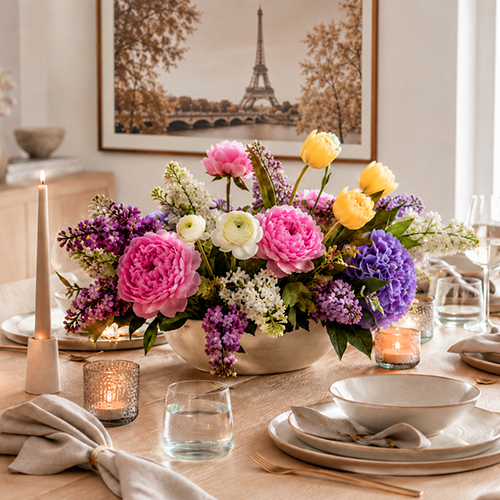
Artificial flower ideas for the dining table
Artificial flowers are particularly useful for table decoration because they stay attractive throughout the day and can be prepared well in advance.
For a dining table, the arrangement should look decorative without becoming too dominant. Low or medium-height arrangements are usually the most practical choice, as they allow people to see one another across the table.
Keep the arrangement proportionate
A large bouquet can work beautifully on a spacious dining table, but on a smaller table it may quickly feel overcrowded.
A compact arrangement with a few selected flowers often creates a more elegant result. You can also divide the flowers between two or three smaller vases instead of using one large centrepiece.
This creates a relaxed look and makes it easier to adapt the decoration to the size of the table.
Match the flowers to the occasion
Artificial flowers can be styled for everyday interiors as well as special occasions.
- soft pink, cream and white flowers create a romantic atmosphere
- hydrangeas and greenery work well for fresh, contemporary table styling
- warm beige, orange and burgundy tones suit autumn-inspired decoration
- white flowers with green foliage create a calm and elegant look
- branches, berries and deeper colours can be used for winter arrangements
Because the flowers can be stored and reused, individual stems can also become part of a seasonal decorating collection.
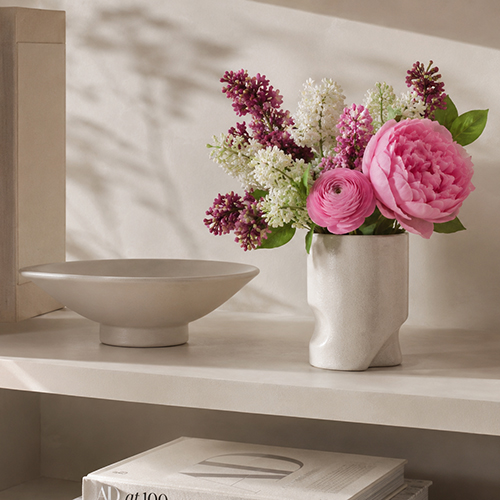
How to style artificial flowers on shelves and sideboards
Artificial flowers do not always need to be displayed as a large bouquet. A single stem or a small arrangement can be enough to add softness and colour to a shelf, sideboard or console table.
Use small arrangements as decorative accents
On shelves, smaller arrangements usually work better than large bouquets.
A single flower, a short branch or two or three stems in a compact vase can create a subtle decorative accent without making the shelf look crowded.
Artificial flowers can be combined with other decorative objects such as:
- books
- candles
- picture frames
- bowls
- trays
- small sculptures or decorative figures
The aim is to create a balanced composition rather than filling every available space.
Vary heights and shapes
A shelf or sideboard looks more interesting when the objects are not all the same height.
For example, place a small vase beside a taller lamp, a stack of books or a framed picture. The flowers then become part of the overall arrangement rather than appearing as an isolated decorative object.
Asymmetrical compositions often feel more natural and contemporary than perfectly mirrored arrangements.
Which artificial flowers suit different interior styles?
The same artificial flowers can create very different effects depending on the vase, colours and surrounding accessories.
Modern and minimalist interiors
For modern interiors, keep the arrangement simple.
Choose a limited colour palette and use only a few stems. White flowers, soft neutrals, eucalyptus or sculptural branches work particularly well in ceramic, stoneware or simple glass vases.
Rather than creating a dense bouquet, leave enough space between the stems to emphasise their shape.
Country-style interiors
Country-inspired interiors can accommodate fuller and more romantic arrangements.
Hydrangeas, roses and other garden-style flowers look particularly attractive in ceramic jugs, rustic vessels or softly coloured vases.
A slightly looser arrangement helps create the impression of freshly gathered flowers.
Romantic and French-inspired interiors
Soft colours such as blush pink, cream, white and pale green work well in romantic or French-inspired spaces.
Roses, peonies and hydrangeas can be combined with delicate foliage and displayed in elegant ceramic or classic glass vases.
The arrangement should remain relaxed rather than overly formal.
Contemporary natural interiors
If your home features wood, stone, linen or other natural materials, artificial flowers can provide a gentle decorative contrast.
Muted colours, leafy branches, eucalyptus and softly coloured blossoms fit particularly well with this style.
Here, fewer stems often create the most convincing effect.
How to choose colours for artificial flower arrangements
The colour of an arrangement has a strong influence on how it works within a room.
One simple approach is to pick up colours that already appear elsewhere in the interior, for example in cushions, curtains, artwork or decorative accessories.
For a harmonious look, use:
- similar shades within one colour family
- neutral flowers with green foliage
- one dominant flower colour with subtle supporting tones
If you want the arrangement to become a focal point, you can instead choose a contrasting colour.
A bright pink or deep burgundy arrangement, for example, can stand out beautifully in an otherwise neutral room.
The important thing is not to use too many competing colours at once. A restrained palette usually looks more sophisticated and allows the individual flowers to have more impact.
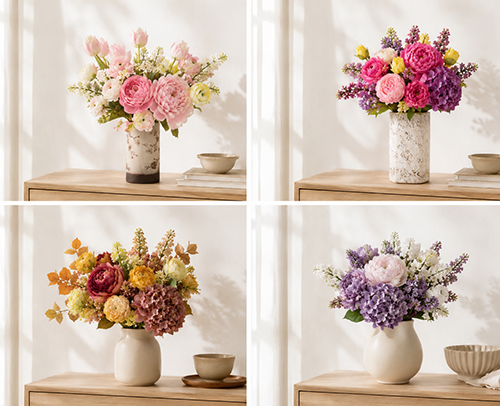
Seasonal decorating ideas with artificial flowers
One of the biggest advantages of artificial flowers is that they can be reused throughout the year and adapted to different seasons.
Instead of replacing the entire arrangement, you can simply exchange individual stems, add seasonal foliage or change the vase.
Spring
Spring arrangements work particularly well with light, fresh colours. Tulips, ranunculus, peonies and delicate blossom branches in soft pink, white and pale green create a fresh and airy look.
Summer
Hydrangeas, roses and meadow-inspired flowers combine well with fresh green foliage. Pink, coral, blue and white can create a bright and cheerful summer arrangement.
Autumn
Muted orange, burgundy, beige and deep green tones work beautifully with branches, berries or dried-looking foliage.
Winter
White flowers, dark green foliage and berries create an elegant winter look that can work well beyond Christmas.
How to make artificial flowers look more natural
High-quality artificial flowers can look remarkably realistic, but styling plays an important role.
A few simple details can make the difference between an arrangement that looks artificial and one that blends naturally into the room.
Bend the stems slightly
Perfectly straight stems can make an arrangement look rigid. Gently bending individual stems creates a more natural growth direction and allows the flowers to sit at different angles.
Turn the flower heads in different directions
Avoid positioning every bloom so that it faces directly forwards. Some flowers can face slightly to the side, while others sit higher or lower within the arrangement.
Avoid perfect symmetry
Real flowers rarely grow in perfectly balanced shapes. An arrangement that is slightly asymmetrical often looks more natural, especially in contemporary interiors.
Mix different stages and shapes
Where possible, combine larger blooms with smaller flowers, buds, greenery and branches. This adds visual variety and creates the impression of a naturally composed arrangement.
Choose realistic colours
Soft colour transitions, subtle differences between petals and naturally toned greenery generally create a more authentic effect than very intense or perfectly uniform colours.
Common mistakes when decorating with artificial flowers
Using too many flowers
Overfilling a vase can make even high-quality flowers look heavy. Start with fewer stems and add more only if the arrangement still feels too sparse.
Choosing the wrong vase size
If the vase is too small, the bouquet can look top-heavy. If it is too large, the flowers may disappear visually.
Making every stem the same length
Uniform stem lengths often create a stiff, artificial appearance. Varying the heights slightly gives the arrangement more movement.
Forgetting the surroundings
A large bouquet may work beautifully on a sideboard but feel impractical on a small dining table. Always consider the scale of the furniture and the room.
How to care for artificial flowers
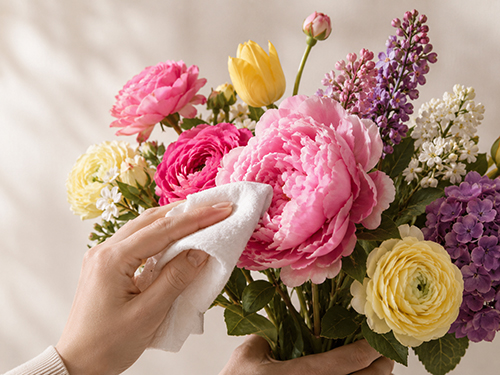
Artificial flowers require very little maintenance, but occasional cleaning helps them stay attractive.
Dust can collect on petals and leaves over time, particularly on arrangements displayed on open shelves or sideboards.
- remove loose dust gently with a soft cloth or feather duster
- use a soft brush for detailed petals and leaves
- avoid harsh cleaning products
- keep delicate flowers away from excessive moisture
- store seasonal arrangements in a clean, dry place
Depending on the material, some artificial flowers may also be sensitive to prolonged direct sunlight, which can cause colours to fade over time.
If possible, avoid positioning them permanently in very strong sunlight.
Artificial flowers as long-lasting interior decoration
Artificial flowers offer plenty of possibilities for changing the atmosphere of a room without constantly replacing fresh bouquets.
A few carefully selected stems can be enough to decorate a vase, dining table, shelf or sideboard, while larger arrangements can become a focal point in an entrance area or living room.
The most natural-looking results usually come from keeping the arrangement slightly loose, varying the height of the stems and choosing flowers and colours that suit the surrounding interior.
If you prefer the character of a real flower while still looking for a long-lasting alternative to a fresh bouquet, preserved roses offer another option. Unlike artificial flowers, preserved roses are real flowers that have been specially treated to retain their appearance for much longer.
With the right styling, artificial flowers can become a versatile part of your home decor throughout the year.
Frequently asked questions about decorating with artificial flowers
How do you make artificial flowers look good in a vase?
Choose a vase that suits the height and volume of the flowers, vary the stem lengths and avoid arranging every bloom at the same angle. Adding foliage and leaving some space between individual stems can also create a more natural effect.
Should you put water in a vase with artificial flowers?
No. Artificial flowers do not need water. Keeping the vase dry is usually the most practical option and avoids unnecessary moisture around the stems and materials.
How many artificial flowers should you put in a vase?
There is no fixed number. It depends on the size of the vase and the flowers. In many cases, fewer carefully arranged stems look more natural than a tightly packed bouquet.
Which artificial flowers look the most natural?
Flowers with detailed petals, subtle colour variations and realistic foliage tend to look the most convincing. Roses, hydrangeas, peonies and high-quality leafy branches can work particularly well when arranged naturally.
Can artificial flowers be used as table decorations?
Yes. Artificial flowers are well suited to table decoration because they do not wilt and can be prepared in advance. For dining tables, lower arrangements are usually best so that they do not obstruct the view across the table.
Can artificial flowers fade in sunlight?
Yes. Depending on the material and colouring, prolonged exposure to strong direct sunlight can cause artificial flowers to fade. A position away from intense sunlight can help preserve their appearance for longer.


