
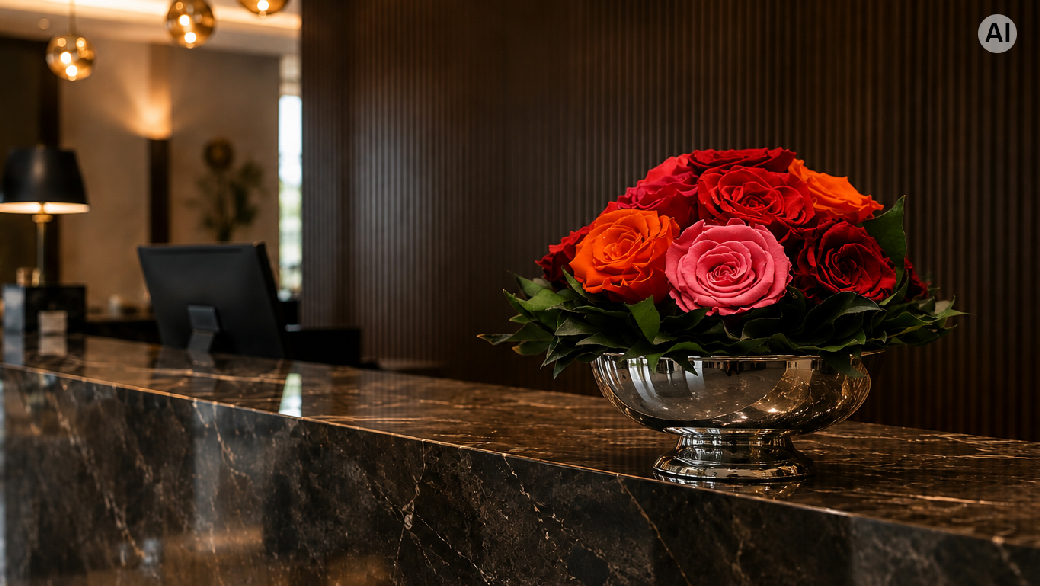
A preserved rose arrangement adds colour and elegance to a hotel reception without the daily care required by fresh flowers. AI-modified image.
The reception area is often the first part of a hotel that guests truly notice. It sets the tone for the entire stay – whether the atmosphere is elegant and understated, warm and welcoming, or contemporary and distinctive.
Fresh flowers can create an inviting impression, but they also require regular watering, replacement and attention. In a busy hotel environment, where reception teams already have numerous daily responsibilities, maintaining fresh floral arrangements is not always practical.
Long-lasting floral décor offers an attractive alternative. Preserved roses, high-quality artificial flowers, dried flowers and preserved moss can retain their decorative appearance for a long time while requiring very little day-to-day care.
The result does not have to feel purely practical. Carefully selected arrangements can become an integral part of the hotel's interior design and help create a reception area that looks considered, welcoming and stylish every day.
Why low-maintenance décor works so well in hotels
Fresh-cut flowers can make a reception area feel welcoming, but they also require regular watering, care and replacement. In a busy hotel environment, with changing shifts and many daily responsibilities, this level of attention is not always easy to maintain consistently.
Long-lasting floral décor offers a more practical alternative. Preserved and artificial arrangements retain their shape and appearance over an extended period, making the overall design easier to plan. They can also help the lobby look polished during busy periods, events, trade fairs or times of high occupancy.
Low-maintenance does not mean completely maintenance-free. Artificial flowers and decorative containers should be dusted occasionally, while preserved moss should be protected from direct sunlight and high humidity. The amount of care required, however, is considerably lower than with fresh flowers.
For hotels, this creates a useful balance: the reception area can maintain a carefully designed, welcoming appearance without creating an additional daily task for the team.
Preserved rose arrangements as a statement piece
Floral arrangements with preserved roses are particularly well suited to boutique hotels, elegant city hotels and individually designed reception areas. Because the roses are real and carefully preserved, they combine a natural appearance with a long-lasting, refined look – without the need for water.
If you would like to know more about the preservation process, our guide explains what preserved roses are and how they differ from fresh-cut flowers.
Presented in high-quality ceramic vessels, these arrangements can feel like a permanent part of the interior rather than temporary floral decoration. Soft shades such as cream, white and blush complement bright, contemporary lobbies, while burgundy, deep red and gold tones work particularly well with dark wood, brass details and warm lighting.
For a smaller reception desk, one carefully chosen arrangement is often enough. In a spacious lobby, several coordinated pieces can be placed on consoles, side tables or raised pedestals. The important point is to preserve clear sightlines and sufficient working space for the reception team.
Important: protect preserved roses from frequent touching
Preserved roses look so natural that guests may be tempted to touch them to check whether they are real. Repeated touching, pressing or brushing against the petals can gradually damage their delicate surface.
For this reason, arrangements should be clearly visible but positioned outside the immediate reach of guests. Suitable locations include a raised console behind the reception desk, a side niche, a pedestal or a sufficiently deep reception counter.
It is also advisable to keep the arrangements away from luggage, busy walkways and areas easily reached by children. Thoughtful placement not only protects the flowers but also helps the overall reception design feel calmer and more sophisticated.
Artificial flowers for flexible hotel décor
High-quality artificial flowers are a practical choice for hotels that want decorative flexibility throughout the year. Unlike fresh flowers, they do not wilt, need water or have to be replaced after only a few days.
They are particularly useful in reception areas where décor is changed seasonally or adapted to special occasions. A neutral arrangement of hydrangeas, roses or foliage can remain in place for much of the year, while individual stems or accent colours can be exchanged to create a different look for spring, summer, autumn or Christmas.
Modern artificial flowers can also work well in locations where real flowers are less practical, such as shelves, darker corners, console tables or areas close to air conditioning.
Choose quality over quantity
For hotel interiors, a smaller number of realistic flowers usually looks more refined than an oversized arrangement with too many different varieties.
Look for natural proportions, subtle colour variations and stems that can be arranged individually. Combining flowers with carefully selected foliage can make the composition appear softer and more authentic.
The vase also plays an important role. Ceramic, glass or metal vessels can connect the floral arrangement with other materials already used in the lobby and help the decoration feel like part of the overall interior concept rather than an isolated accessory.
For hotels that regularly redesign their reception area, artificial flowers therefore offer an especially versatile solution: they can be rearranged, combined and reused again and again.
Dried flowers for a warm, natural atmosphere
Dried flowers are a good choice for hotels that want to create a softer, more organic interior style. Their muted colours and natural textures work particularly well in boutique hotels, country-style properties and reception areas with wood, stone, linen or other tactile materials.
Unlike fresh bouquets, dried arrangements require no water and can remain decorative for a long period when they are kept in a suitable location. Pampas grass, dried grasses, eucalyptus and selected dried flowers can be combined to create anything from a compact reception arrangement to a larger statement piece on a console table.
Natural beige, cream and warm brown tones create a calm, understated look. If the lobby needs a little more colour, individual dried flowers in soft pink, burgundy or seasonal shades can be added without making the arrangement feel too busy.
Keep dried flowers away from busy walkways
Dried flowers are low-maintenance, but some varieties can be relatively delicate. For this reason, they are best placed where guests and luggage are unlikely to brush against them.
A sideboard, wall console or decorative niche is often more suitable than the edge of a busy reception desk. Occasional gentle dusting is usually sufficient to keep the arrangement looking attractive.
Because dried flowers naturally develop a slightly softer and more informal appearance than preserved roses, they are especially effective when the hotel interior is intended to feel relaxed, warm and welcoming.
Preserved moss for walls, logos and reception features
Preserved moss offers a different way to introduce natural green tones into a hotel reception area. Instead of using a vase or floral arrangement, moss can become part of the architecture itself – for example as moss pictures, moss walls, lettering or a hotel logo.
This works particularly well in modern lobbies where clean lines and natural materials are combined. Green moss creates a strong visual contrast with wood, stone, concrete, black metal or warm metallic finishes and can make a reception area feel more inviting without taking up valuable counter space.
Moss pictures for smaller reception areas
A framed moss picture is a practical option when there is not enough space for large floral arrangements. It can be placed behind the reception desk, above a console or in a waiting area and acts almost like a piece of botanical wall art.
Different types of preserved moss create different effects. Cushion moss has a soft, sculptural appearance with natural variations in height, while preserved reindeer moss creates a finer, more even surface.
Moss lettering and logos for stronger branding
For hotels with a distinctive visual identity, preserved moss can also be incorporated into letters, signs or logos. A hotel name or individual initials made with moss can connect branding with interior design in a subtle and memorable way.
This is especially effective behind the reception desk, where the feature naturally becomes part of the guest's first impression.
Preserved moss does not need watering or regular trimming. It should, however, be used indoors and protected from direct sunlight and excessive humidity. When placed in suitable conditions, it provides a long-lasting decorative element with very little ongoing maintenance.
For hotels looking for an alternative to conventional floral decoration, moss can therefore be an especially attractive solution – natural in appearance, space-saving and visually distinctive.
Consider size, sightlines and safety
Before choosing décor for a hotel reception, it is worth looking closely at how the space is actually used. Where are room keys handed over? Where do guests place handbags or luggage? Which surfaces are needed for documents, card terminals or other reception equipment?
On the reception counter itself, low and stable decorative objects are usually the most practical choice. Taller arrangements can be placed on side consoles, wall-mounted features or protected pedestals, where they add height without interfering with daily operations. Heavier ceramic vessels are generally more secure than lightweight vases in busy areas.
As a general rule, hotel décor should be clearly visible without being too easy to touch. This helps protect delicate preserved roses, artificial flowers and dried arrangements from accidental contact and prevents decorative objects from becoming an obstacle for staff or guests.
A well-positioned arrangement should enhance the reception area while leaving the space around it calm, functional and easy to navigate.
Choose colours that suit the hotel
The colours used in the reception area should complement the hotel's architecture, furnishings and overall brand identity. Neutral shades such as cream, sand, white and taupe create a calm, timeless impression and work particularly well in light, contemporary interiors.
For a richer and more elegant atmosphere, deeper colours can be introduced. Dark green, burgundy, plum and gold tones add depth and can work beautifully with dark wood, brass, marble or warm lighting.
Stronger colours are most effective when used deliberately. Rather than combining many different shades, one distinctive arrangement in a carefully selected colour can often create a more sophisticated and memorable result.
The same principle applies to seasonal decoration. A neutral base can remain in place throughout the year, while selected floral accents are changed to reflect the season or a special event. This keeps the reception area visually fresh without requiring a complete redesign each time.
Above all, the decoration should feel connected to the hotel itself. When colours, materials and proportions are coordinated with the surrounding interior, floral décor becomes part of the overall design rather than simply an additional accessory.
Which type of décor suits which hotel?
There is no single decorative concept that works equally well for every hotel. The best choice depends on the architecture, target audience and atmosphere of the property.
Boutique hotels
Boutique hotels often benefit from distinctive decorative elements with character. Preserved rose arrangements, unusual colour combinations or individually designed moss features can support a more personal and curated interior style.
Modern city hotels
For contemporary urban hotels, clean shapes and restrained colours usually work best. Artificial flowers in sculptural vases, compact preserved rose arrangements or moss pictures can add softness without making the reception area feel overly decorative.
Country and country-house hotels
Dried flowers, grasses and natural materials are especially suitable for warmer, more rustic interiors. Soft beige, cream and muted green tones can complement wood, stone and traditional furnishings particularly well.
Luxury hotels
In more luxurious interiors, quality and restraint are especially important. A single carefully positioned arrangement of preserved roses can often create more impact than several smaller decorative pieces.
High-quality vessels, coordinated colours and sufficient space around each element help create a refined appearance.
Business hotels
Business hotels generally benefit from décor that is understated, durable and easy to maintain. Artificial flowers, compact moss features or neutral preserved arrangements can introduce warmth without distracting from the clear, functional character of the reception area.
The most successful solution is therefore not necessarily the largest or most elaborate one. It is the décor that feels naturally integrated into the hotel and supports the atmosphere guests are meant to experience.
A reception area that fits the hotel long term
Low-maintenance décor does not have to look like a purely practical solution. High-quality arrangements with preserved roses, carefully selected artificial flowers or an individually designed moss picture can become a permanent part of the hotel's interior concept.
The key is to coordinate the decoration with the colours, architecture and atmosphere of the property. In many cases, one distinctive statement piece creates a stronger impression than several smaller decorative objects.
At Rosemarie Schulz, long-lasting floral arrangements can be created to complement different interiors and colour schemes. This makes it possible to design a reception area that feels considered and welcoming every day – while keeping ongoing maintenance to a minimum.
Ultimately, successful hotel décor is about more than filling an empty surface. It helps shape the first impression and shows guests from the moment they arrive that attention has been paid to the details.
Frequently asked questions about low-maintenance hotel reception décor
What is the best low-maintenance décor for a hotel reception?
Preserved roses, high-quality artificial flowers, dried flowers and preserved moss are all suitable options. The best choice depends on the size of the reception area, the hotel's interior style and how much flexibility is required.
Do preserved roses need water?
No. Preserved roses should never be placed in water. They are real roses that have been specially preserved and are designed for indoor decoration without watering.
How long can preserved roses remain decorative?
With suitable indoor conditions and careful handling, preserved roses can retain their attractive appearance for a long period. They should be protected from direct sunlight, high humidity and frequent touching.
Are artificial flowers suitable for luxury hotels?
Yes. High-quality artificial flowers can work very well in elegant hotel interiors, particularly when realistic flowers are combined with sophisticated vessels and restrained colour schemes. Quality, proportion and placement are more important than the quantity of flowers used.
Is preserved moss suitable for hotel reception areas?
Yes. Preserved moss is particularly suitable for wall-mounted decoration such as moss pictures, lettering and logos. It requires no watering and can introduce natural green tones without using valuable counter space.
How often does low-maintenance hotel décor need to be cleaned?
The exact frequency depends on the location. Artificial flowers and decorative vessels should be dusted occasionally, while preserved roses, dried flowers and moss should be handled as little as possible. Gentle cleaning and thoughtful placement are usually sufficient.
Can hotel reception décor be adapted to the seasons?
Yes. A permanent neutral arrangement can be supplemented with seasonal colours or individual decorative elements. Artificial flowers are especially practical for this because individual stems can be exchanged and reused throughout the year.


