
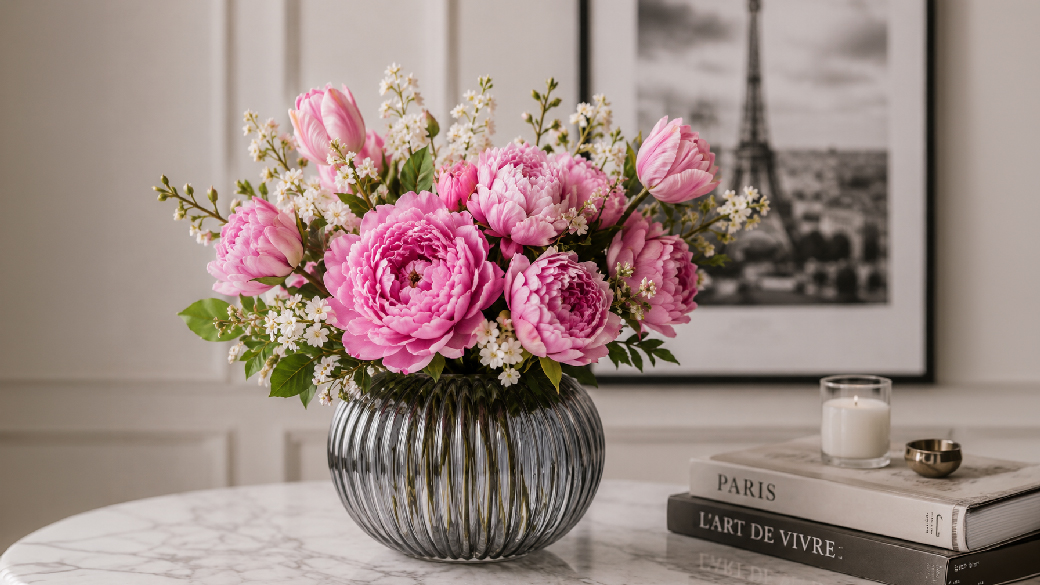
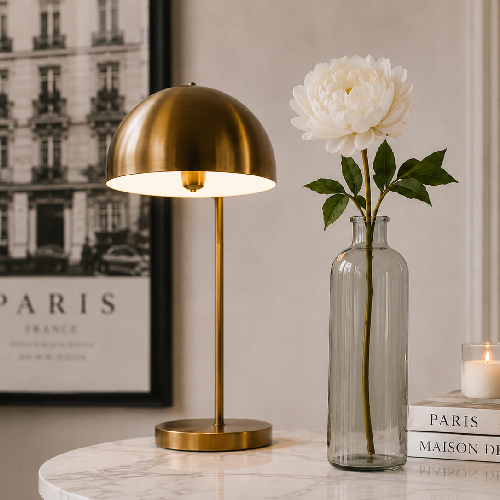
Choosing high-quality artificial flowers is about more than colour – realistic details, proportions and the right arrangement all make a difference. AI-modified lifestyle image.
High-quality artificial flowers can bring colour and character into a room all year round – without wilting, needing water or having to be replaced regularly. But there can be a considerable difference between a simple artificial bloom and a carefully made flower designed to look natural.
When buying artificial flowers, it is therefore worth looking beyond colour and price. The material, finish, proportions, shape of the petals and even the vase you plan to use can all influence how realistic and harmonious the finished arrangement looks.
In this guide, we explain what to look for when choosing artificial flowers, which types of blooms tend to look particularly natural and how to find flowers that suit your vase, interior and intended setting.
Post Contents [hide]
- Why choose high-quality artificial flowers?
- Buying artificial flowers: key quality features to look for
- Which artificial flowers look most realistic?
- Individual stems, bouquets or ready-made arrangements?
- What size artificial flowers should you choose?
- How many artificial flower stems do you need?
- Choosing flowers to suit your vase
- Which artificial flowers suit your interior style?
- Buying artificial flowers online: what to look for
- Common mistakes when buying artificial flowers
- Choosing artificial flowers as a gift
- Artificial flowers for offices and commercial spaces
- Combining artificial flowers with other floral materials
- How to care for artificial flowers
- Conclusion: choosing artificial flowers with confidence
Why choose high-quality artificial flowers?
Artificial flowers are especially practical when you want a decorative floral element that remains attractive over a long period of time. Unlike fresh flowers, they do not wilt, require no water and can be used again and again in different arrangements.
Higher-quality artificial flowers also tend to look noticeably more natural. Carefully shaped petals, realistic colour gradients and well-proportioned leaves can make individual stems appear surprisingly lifelike, especially when they are arranged loosely rather than too symmetrically.
They are particularly suitable for:
- living rooms, dining areas and bedrooms
- entrance halls and hallways
- offices, reception areas and meeting rooms
- restaurants, boutiques and hotels
- seasonal decorations and table arrangements
- rooms with little natural light
- households where low-maintenance decoration is preferred
Another advantage is flexibility. Individual stems can be rearranged, combined with other flowers or adapted to a different vase whenever you want to change the look of a room.
For this reason, it is often worth investing in a few carefully selected high-quality artificial flowers rather than buying a large number of inexpensive flowers that look less natural.
Buying artificial flowers: key quality features to look for
At first glance, many artificial flowers can look quite similar, especially in online product photos. The difference in quality often becomes visible in the details. When choosing artificial flowers, pay particular attention to the shape of the petals, surface texture, colours, finish and stems.
1. Naturally shaped petals
Real flowers are rarely perfectly symmetrical. High-quality artificial flowers can therefore benefit from small irregularities, such as slightly curved petals, different levels of openness or blooms facing in different directions.
If every flower in a bouquet has exactly the same shape, the arrangement can quickly look artificial. Roses, peonies and hydrangeas usually appear more realistic when the individual blooms vary slightly.
2. Matt, finely textured surfaces
A strong plastic-like shine is often one of the clearest signs of a lower-quality artificial flower. Better-quality petals and leaves usually have a matt finish or only a subtle natural sheen.
Look for details such as delicate leaf veins, textured surfaces and slight variations in colour. Fabric petals should also have neatly finished edges without obvious fraying.
3. Natural colour variations
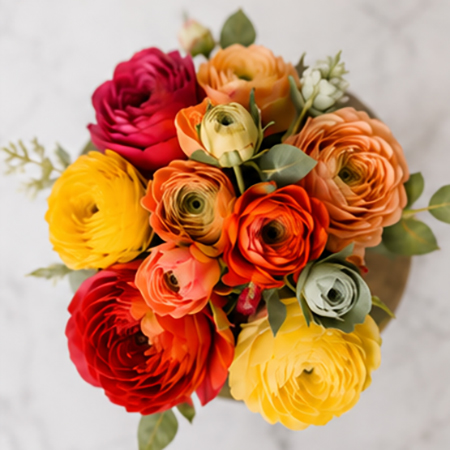
Real flowers rarely consist of one completely uniform shade. Subtle colour gradients therefore make artificial blooms look more convincing.
A rose, for example, may be slightly deeper in colour towards the centre, while hydrangeas often look particularly natural when several related shades appear within one flower head.
Soft tones such as cream, blush pink, apricot, white and muted reds are particularly versatile if you are looking for a natural appearance.
4. Neat finishing and transitions
Pay attention to the points where petals, leaves and stems meet. Visible glue, rough plastic joins or unfinished fabric edges can reduce the overall quality of an otherwise attractive flower.
This is especially important for arrangements placed at eye level or viewed from close range, such as flowers on a dining table, sideboard or reception desk.
5. Flexible yet stable stems
A good artificial flower stem should be strong enough to support the bloom while still allowing some adjustment. Many high-quality stems contain a flexible wire core.
This makes it possible to gently bend a stem, change the direction of a flower head or adapt the arrangement to the shape of a particular vase.
The best stems therefore offer a balance between stability and flexibility – giving the arrangement structure without making it look rigid.
Which artificial flowers look most realistic?
Some flower varieties are particularly well suited to artificial reproduction because their natural shape, layered petals or structured leaves can be recreated very convincingly.
Artificial roses
Roses are one of the most versatile choices. High-quality artificial roses can look especially realistic when the petals have slightly irregular edges, subtle colour gradients and a natural arrangement around the centre of the bloom.
They work well both as individual stems and in larger bouquets and are suitable for classic, romantic and modern interiors.
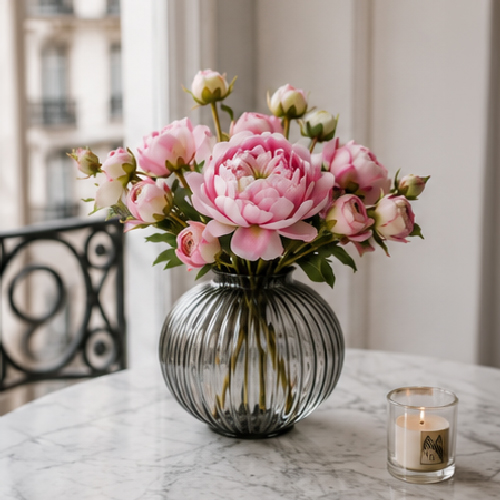
Artificial peonies
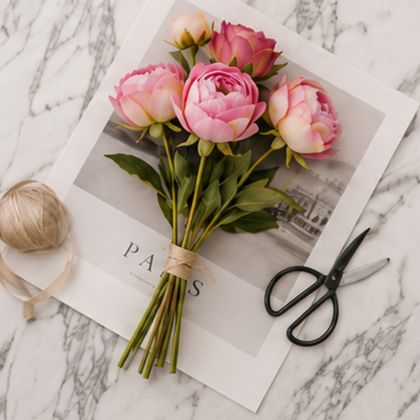
Peonies are ideal if you prefer a softer, more voluminous look. Their many layers of petals make them particularly attractive in artificial form, especially when the blooms are not too perfectly shaped.
Soft pink, cream, white and muted blush tones tend to look especially natural.
Artificial hydrangeas
Hydrangeas are popular because a single stem already creates plenty of volume. Their flower heads can look very convincing when they contain different shades rather than one completely uniform colour.
They are particularly suitable for generous arrangements in larger vases.
Artificial ranunculus
Ranunculus flowers have compact, densely layered petals and work particularly well in smaller arrangements. They can add a delicate, elegant touch without making a bouquet appear too formal.
Artificial tulips
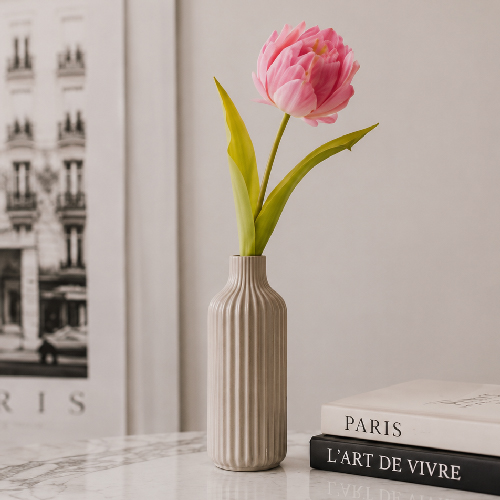
Tulips are simple in shape, which means proportions and stem quality are especially important. Slightly curved stems and flower heads that face in different directions usually create a more natural appearance than perfectly upright, identical blooms.
Artificial orchids and magnolias
Orchids and magnolia branches can make a strong decorative statement even when used on their own. Because of their distinctive flower shapes, however, details such as petal texture, colour transitions and realistic branches are particularly important.
Eucalyptus, grasses and decorative foliage
Artificial greenery can make an arrangement look more relaxed and natural. Eucalyptus, grasses and leafy branches are especially useful for adding height, structure and movement between larger flowers.
A combination of different flower shapes and greenery often appears more convincing than a bouquet made entirely from identical blooms.
When choosing artificial flowers, the variety itself is therefore only one factor. The quality of the finish, colour and proportions ultimately determines whether the finished arrangement looks natural.
Individual stems, bouquets or ready-made arrangements?
Artificial flowers are available as individual stems, pre-arranged bouquets and complete decorative arrangements. Which option is best depends mainly on how much flexibility you want and where the flowers will be displayed.
Individual artificial flower stems
Individual stems give you the greatest freedom. You can choose the colours, flower varieties and heights yourself and adjust the arrangement whenever you want.
They are particularly suitable if you:
- already have a favourite vase
- want to create your own colour palette
- like changing decorations seasonally
- prefer loose, natural-looking arrangements
- want to combine flowers with eucalyptus, grasses or decorative branches
A small number of carefully selected stems can often create a more elegant result than a very full bouquet.
Artificial flower bouquets
Ready-made bouquets are a convenient choice if you want a coordinated arrangement without having to select every stem individually.
They can work particularly well when the colours and flower varieties are already balanced and the bouquet has a relaxed, slightly irregular shape.
Before buying, check the overall dimensions carefully. Product photos can sometimes make a bouquet appear larger than it is in reality.
Ready-made artificial flower arrangements
Complete arrangements are ideal when you want a finished decorative piece that can be placed directly on a table, shelf, sideboard or reception desk.
Because the flowers, container and proportions are already coordinated, they require very little styling.
The main consideration is flexibility: unlike individual stems, a fixed arrangement is usually less easy to adapt to another vase or interior.
Ultimately, there is no single best option. Individual stems offer maximum creative freedom, while bouquets and ready-made arrangements are particularly practical when you prefer a coordinated look with minimal effort.
What size artificial flowers should you choose?
The size of an artificial flower arrangement has a major influence on how balanced it looks in a room. A bouquet that is too small can appear lost, while an arrangement that is too large may dominate the furniture around it.
The most important factors are the height of the vase, the width of the surface and the overall scale of the room.
Match the flowers to the vase
As a general rule, the visible flower arrangement should be in proportion to the vase rather than simply as tall as possible.
Longer stems work well in:
- tall floor vases
- large ceramic vases
- narrow statement vases
- entrance areas and spacious rooms
Shorter stems are often better suited to:
- dining tables
- bedside tables
- shelves
- smaller sideboards
- compact decorative arrangements
If the stems are flexible, they can often be shortened visually by bending them slightly inside an opaque vase. Some artificial flower stems can also be carefully trimmed, depending on their construction.
Consider where the flowers will be placed
The same bouquet can have a very different effect depending on its location.
On a dining table, for example, an arrangement should usually remain low enough that people can comfortably see one another across the table. On a sideboard or console table, more height is often possible because the flowers are not blocking anyone's view.
For shelves and smaller surfaces, one or two carefully chosen stems may be enough.
Think about width as well as height
Flower size is not only about stem length. Large hydrangea heads, open peonies or magnolia branches can create considerable visual volume even when the stems are relatively short.
This is why checking both the height and approximate width of an artificial flower arrangement before buying can help you achieve a much more balanced result.
In many interiors, slightly fewer flowers with good proportions will look more elegant than an arrangement that is simply very full.
How many artificial flower stems do you need?
There is no fixed number of artificial flower stems that works for every vase or arrangement. The right quantity depends on the size of the blooms, the width of the vase and whether you prefer a minimal or fuller look.
Large flowers such as hydrangeas or peonies create volume quickly, while slimmer stems such as tulips, roses or eucalyptus usually need to be grouped more generously.
For a simple, modern arrangement
A small number of stems can be enough if the flowers themselves have a strong shape.
For example:
- 1–3 statement stems for a narrow vase
- 3–5 stems for a small table arrangement
- 5–7 stems for a medium-sized vase
- more stems for larger, fuller bouquets
These numbers are only a guide. The proportions of the individual flowers are more important than the exact quantity.
Avoid arrangements that look too uniform
Artificial flowers often look more natural when the bouquet is not perfectly symmetrical.
Try varying the height and direction of the stems slightly. Some blooms can sit lower, while others extend above the main arrangement. This creates depth and makes the flowers appear less rigid.
Use foliage to add volume
If you do not want to use a large number of flower stems, greenery can help create a fuller arrangement.
Eucalyptus, leafy branches or decorative grasses can fill gaps between the blooms while keeping the overall look light and natural.
This approach can be particularly effective with roses, peonies and hydrangeas.
Start with fewer stems
When arranging artificial flowers yourself, it is often best to start with fewer stems and add more gradually.
This makes it easier to see whether the bouquet already has enough volume. In many cases, leaving a little space between the flowers creates a more elegant and realistic result than filling every gap.
Choosing flowers to suit your vase
The vase has a major influence on how artificial flowers are perceived. Even high-quality blooms can look unbalanced if the proportions between vase, stems and flower heads do not work well together.
A good combination should feel intentional without looking overly arranged.
Narrow vases
Slim, narrow-necked vases work particularly well with:
- individual roses
- tulips
- ranunculus
- eucalyptus
- delicate branches
Because the opening is small, only a few stems are usually needed. This makes narrow vases ideal for understated arrangements.
Wide vases
Wider vases are better suited to fuller bouquets and larger flower heads such as:
- hydrangeas
- peonies
- mixed rose arrangements
- magnolia branches
- combinations of flowers and greenery
A wider opening gives the stems more room to spread, creating a softer and more generous silhouette.
Opaque or transparent vases?
Opaque ceramic or metal vases are especially practical for artificial flowers because the lower part of the stems remains hidden.
With transparent glass vases, the stems are clearly visible. In this case, neat and realistic-looking stems become more important because they form part of the overall arrangement.
Artificial flowers should generally be displayed without water unless the product is specifically designed for use with imitation-water effects.
Pay attention to proportion
As a rough visual guide, the flowers should extend clearly above the vase without appearing disproportionately tall.
Rather than relying on a strict formula, consider the complete silhouette: vase, stems and blooms should look balanced as one decorative object.
If the flowers appear too tall, flexible stems can often be bent slightly inside an opaque vase. If they look too compact, removing one or two stems can sometimes create a lighter, more elegant appearance.
The right vase can therefore make a significant difference – not only in how the flowers are displayed, but also in how realistic and refined the entire arrangement feels.
For more styling inspiration, our guide on how to decorate with artificial flowers offers ideas for arranging them in vases, on tables and on shelves.
Buying artificial flowers: key quality features to look for
Which artificial flowers suit your interior style?
Artificial flowers work best when their colours, shapes and proportions complement the overall character of the room. A very romantic bouquet may look out of place in a minimalist interior, while a single sculptural branch can sometimes feel too restrained in a more traditional setting.
The aim is not to match every detail perfectly, but to choose flowers that support the atmosphere you want to create.
Modern and minimalist interiors
For contemporary spaces, fewer stems and cleaner shapes usually work best.
Good choices include:
- tulips
- orchids
- magnolia branches
- eucalyptus
- decorative grasses
- individual roses in muted colours
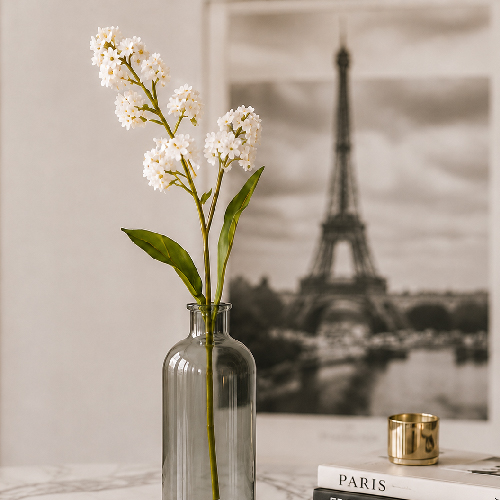
White, cream, soft beige, green and dusty pink can create a calm, understated look. A simple ceramic or glass vase helps keep the arrangement visually light.
Classic and elegant interiors
Roses, peonies and hydrangeas are particularly suitable for more classic interiors.
Soft pink, cream, champagne and muted red tones can create an elegant effect, especially when combined with a traditional ceramic or decorative glass vase.
The arrangement can be fuller than in a minimalist setting, but should still retain some variation in height and shape.
Country and cottage-style interiors
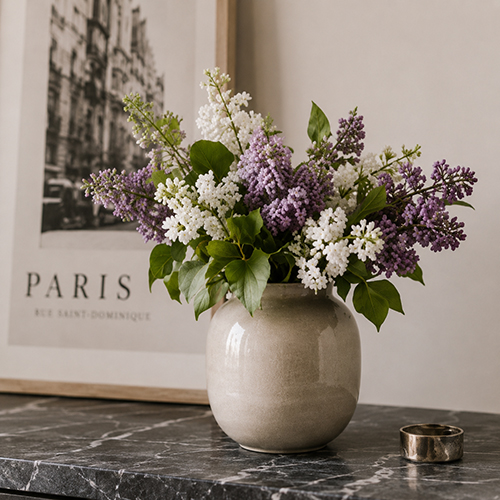
Loose, natural-looking arrangements work especially well with country-inspired interiors.
Consider combining:
- hydrangeas
- roses
- ranunculus
- eucalyptus
- grasses and leafy branches
Soft, slightly faded colours can reinforce the relaxed character of this style.
Scandinavian interiors
Scandinavian interiors usually benefit from simple arrangements with plenty of visual space.
White flowers, pale greenery, eucalyptus and delicate branches work particularly well with light wood, neutral textiles and simple ceramics.
Rather than creating a dense bouquet, use just a few carefully positioned stems.
Romantic interiors
For a softer, more decorative look, peonies, roses and hydrangeas are natural choices.
Blush pink, cream, white and muted berry tones can be combined to create an arrangement that feels romantic without becoming overly sweet.
Seasonal arrangements
Artificial flowers also make it easy to adapt your decoration throughout the year.
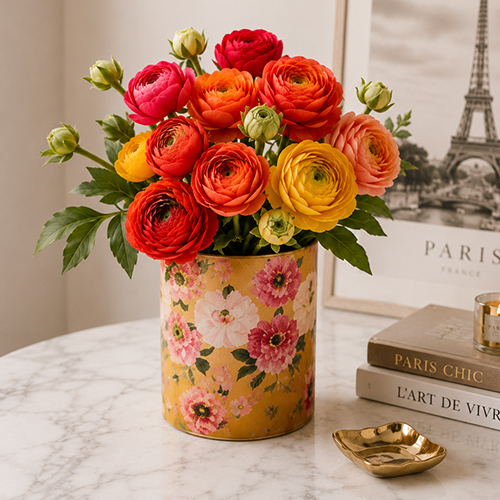
In spring, tulips and light pastel shades can create a fresh look. Summer arrangements can include brighter flowers and airy greenery, while muted reds, warm beige tones and decorative branches work well in autumn.
For winter, white blooms, dark greenery or elegant metallic accents can create a more festive atmosphere.
The most convincing arrangements usually reflect both the interior style and the scale of the room. A few carefully chosen flowers that harmonise with the surrounding colours often create a more sophisticated effect than a large bouquet with too many competing shades.
Buying artificial flowers online: what to look for
Buying artificial flowers online gives you access to a much wider choice of colours, flower types and sizes than you may find locally. At the same time, it can be harder to judge quality from photographs alone.
A careful look at the product information can therefore help you avoid disappointment.
Check the dimensions carefully
One of the most common mistakes when buying artificial flowers online is relying only on the product image.
Always check details such as:
- total stem length
- diameter of the flower head
- width of the arrangement
- number of stems or blooms included
- size of any vase or container shown
A close-up photograph can make a flower appear much larger than it actually is, while a lifestyle image may make it difficult to judge the real proportions.
Look at more than one product photo
Ideally, a product page should show the flowers from several angles.
Close-up images are useful for assessing:
- petal texture
- colour gradients
- leaves
- stems
- overall finish
Lifestyle images, on the other hand, help you understand how the flowers may look in a vase or interior.
Read the material information
The term “artificial flower” can cover many different materials and finishes.
Look for clear information about whether the petals are made from textile, coated fabric or another synthetic material, and whether the stems contain wire that allows them to be adjusted.
The material alone does not determine quality, but detailed product information is generally a good sign that the seller is transparent about the construction of the flower.
Check what is actually included
Product photographs often show artificial flowers styled with vases, decorative objects or additional greenery.
Before ordering, check carefully whether you are buying:
- one individual stem
- a set of stems
- a complete bouquet
- an arrangement including the vase
This is particularly important when comparing prices.
Pay attention to colour representation
Colours can vary slightly depending on lighting, photography and your screen settings.
If you need an exact shade for an existing interior, table decoration or event, look for several photographs taken in different settings rather than relying on a single image.
Choose specialist retailers where possible
A specialist florist or interior retailer is often able to provide more precise information about stem lengths, proportions, flower varieties and suitable combinations.
This can be particularly useful when you are planning a larger arrangement or want to combine several individual stems.
At Rosemarie Schulz, floral arrangements and decorative designs are created in our Heidelberg atelier, where flowers and materials are selected with particular attention to colour, proportion and composition.
When buying artificial flowers online, good product photography and detailed measurements are often just as important as the appearance of the flower itself.
Common mistakes when buying artificial flowers
Choosing artificial flowers is usually straightforward, but a few common mistakes can make even attractive blooms look less convincing once they are placed in a room.
Choosing flowers that are too perfect
Perfect symmetry often makes artificial flowers look less natural. Real blooms vary in shape, direction and level of openness.
Instead of choosing stems that all look identical, look for slight differences in petal position, flower size and colour.
Buying too many stems
A very full bouquet is not always more elegant.
Too many artificial flowers can make an arrangement look dense and rigid, especially when all the stems are the same height.
Starting with fewer stems and adding more only if needed usually creates a lighter, more natural result.
Ignoring the size of the vase
A beautiful flower can still look wrong if the vase is too large, too small or poorly proportioned.
Before buying, check the stem length and flower-head size and compare them with the vase you plan to use.
Focusing only on the flower heads
The petals are important, but so are the leaves and stems.
Visible plastic joins, overly glossy leaves or very rigid stems can quickly reduce the realistic appearance of an otherwise attractive flower.
Choosing colours that do not suit the room
Bright or highly saturated colours can be effective, but they should work with the surrounding interior.
If you are unsure, neutral and muted shades such as cream, white, soft pink, beige and natural green are usually easier to combine.
Using perfectly straight stems
Artificial flowers often arrive with very straight stems. Leaving them completely unchanged can make the arrangement look stiff.
If the stems are flexible, gently bend some of them and vary the direction of the flower heads. Small adjustments can make a noticeable difference.
Forgetting to check the product details
Online photographs do not always show scale clearly.
Checking dimensions, number of stems and what is actually included before ordering can prevent one of the most common sources of disappointment when buying artificial flowers online.
A convincing artificial flower arrangement is usually less about quantity and more about proportion, variation and careful styling.
Choosing artificial flowers as a gift
Artificial flowers can also make a thoughtful decorative gift, especially when you know the recipient’s preferred colours or interior style.
Unlike fresh flowers, they can be enjoyed for a long time and do not require water or regular care. This makes them particularly suitable for people who appreciate decorative flowers but prefer a low-maintenance option.
Choose colours that suit the recipient
If you are unsure which flowers to choose, neutral and soft shades are often the safest option.
Popular choices include:
- white
- cream
- soft pink
- blush
- beige
- muted green
These colours are easy to integrate into many interiors and tend to create an elegant, understated look.
For someone who enjoys stronger colours, individual stems in red, coral, yellow or deeper pink tones can create a more personal statement.
Consider the recipient’s interior style
A minimalist home may suit a single orchid, magnolia branch or a few tulip stems, while a more romantic interior may be better suited to roses, peonies or hydrangeas.
If you know the recipient’s favourite vase style or colour scheme, this can also help you choose flowers that will fit naturally into their home.
Individual stems or a complete arrangement?
Individual artificial flower stems are a good option for someone who enjoys arranging flowers themselves.
A ready-made bouquet or complete arrangement, on the other hand, can be more convenient when you want to give a finished decorative piece.
For an especially coordinated gift, artificial flowers can also be combined with a suitable vase.
Suitable occasions
Artificial flowers can be given for many different occasions, including:
- birthdays
- housewarmings
- Mother’s Day
- anniversaries
- thank-you gifts
- invitations and hostess gifts
Because they are decorative rather than seasonal, they can also be a suitable gift when you want something that remains visible long after the occasion itself.
The most important consideration is not simply choosing the most elaborate bouquet, but selecting flowers that reflect the recipient’s taste and living environment.
Artificial flowers for offices and commercial spaces
Artificial flowers are particularly practical in professional environments because they provide a decorative effect without requiring regular watering, replacement or special lighting conditions.
They can be used in:
- reception areas
- offices
- meeting rooms
- restaurants
- hotels
- boutiques
- salons
- waiting areas
Choose arrangements that suit the space
In commercial interiors, the scale of the arrangement is especially important.
A small bouquet may disappear visually in a large reception area, while an oversized arrangement can feel intrusive on a meeting table or reception desk.
For larger spaces, hydrangeas, magnolia branches and generous mixed arrangements can create presence. Smaller surfaces often benefit from simpler combinations of roses, tulips or eucalyptus.
Keep the look consistent
Artificial flowers can help reinforce an interior concept or brand atmosphere.
For example, neutral colours such as white, cream, beige and green create a calm and sophisticated impression, while stronger colours can be used selectively as accents.
Repeating similar flower varieties or colour palettes in different areas can also create a more coherent overall look.
Consider durability and maintenance
Artificial flowers used in commercial spaces are often handled less carefully than those in a private home. Stable stems and well-finished leaves and petals are therefore particularly important.
They should also be easy to dust and clean, especially in reception areas, restaurants or shops where presentation matters.
Avoid overcrowding
In professional interiors, artificial flowers usually work best as part of the overall design rather than as the dominant feature.
A few well-placed arrangements can create a more refined impression than decorating every surface.
Used thoughtfully, high-quality artificial flowers can provide a consistent, low-maintenance decorative element throughout the year.
Combining artificial flowers with other floral materials
Artificial flowers can look beautiful on their own, but they can also be combined with other long-lasting floral materials to create more varied and natural-looking arrangements. The key is to repeat colours, shapes or textures so that the different elements feel connected rather than randomly mixed.
Combine artificial flowers with dried flowers
Soft, neutral artificial flowers can work particularly well with dried grasses, seed heads or other natural dried elements.
For example, an artificial rose in cream or blush pink can be combined with delicate dried grasses to create a relaxed arrangement with different textures.
When mixing the two, it is usually best to keep the colour palette relatively restrained. Two or three related tones help the arrangement remain harmonious.
If you use natural dried elements in your arrangement, our guide explains how to care for dried flowers and keep them looking beautiful for longer.
Add eucalyptus, foliage and branches
Artificial eucalyptus, leafy stems and fine decorative branches are useful for creating transitions between larger flower heads.
They can:
- add height and movement
- soften the outline of a bouquet
- create space between larger blooms
- make an arrangement appear less compact
- introduce different shades of green
This is particularly effective with roses, peonies and hydrangeas.
Combine different textures
A convincing arrangement does not need every element to have the same surface or structure.
Smooth petals, textured leaves, airy grasses and slender branches can complement one another and give the bouquet more depth.
The important point is balance. Too many competing materials, colours and flower shapes can quickly make an arrangement feel busy.
Artificial flowers and preserved roses
Preserved roses offer another long-lasting floral option, although they are fundamentally different from artificial flowers.
Infinity Roses are real roses that have been carefully preserved so that their natural appearance can be enjoyed for an extended period. Artificial flowers, by contrast, are manufactured decorative flowers and can usually be bent, rearranged and restyled more freely.
If you would like to understand the difference in more detail, our guide explains what preserved roses are and how their natural appearance is retained for much longer than with fresh-cut roses.
Both therefore have their own advantages: artificial flowers offer considerable flexibility when creating arrangements, while preserved roses retain the distinctive character of a real rose.
Preserved flowers also require different treatment from artificial blooms. Our separate guide explains how to care for preserved roses so they remain beautiful for as long as possible.
Combining floral materials thoughtfully can create arrangements that feel more individual and layered without becoming overly elaborate.
How to care for artificial flowers
Artificial flowers require very little maintenance, but occasional cleaning helps them retain their colour and natural appearance.
Remove dust regularly
Dust is usually the main reason artificial flowers begin to look dull over time.
For light cleaning, you can use:
- a soft feather duster
- a clean, dry microfibre cloth
- a soft brush for delicate petals
- a hairdryer on a cool, low setting and from a safe distance
Be particularly careful with fine textile petals and delicate leaves.
Avoid strong sunlight
Although artificial flowers do not wilt like fresh flowers, prolonged exposure to strong direct sunlight can cause some colours and materials to fade over time.
If possible, avoid placing them permanently in very sunny windows or other areas exposed to intense UV light.
Keep them away from moisture
Most decorative artificial flowers are designed primarily for dry indoor use.
Unless the manufacturer specifically states otherwise, avoid leaving them in water or exposing them to high humidity for long periods. This can affect wire stems, adhesives and textile materials.
Reshape the stems when necessary
Flexible stems and leaves may change position during storage or transport.
Gently bending them back into shape can restore a more natural appearance. Rather than making every stem perfectly straight, slight differences in height and direction often make the arrangement look more realistic.
Store them carefully
If you change your artificial flowers seasonally, store them in a dry place where the blooms will not be crushed.
Larger flower heads such as peonies and hydrangeas benefit from having enough space around them so that the petals retain their shape.
With a little occasional care, good-quality artificial flowers can remain an attractive and versatile part of your interior decoration for many years.
Conclusion: choosing artificial flowers with confidence
When buying artificial flowers, the most important factors are quality, proportion and how well the flowers suit their surroundings.
Look for natural shapes, subtle colour variations, matt or finely textured surfaces and flexible stems. At the same time, consider the size of your vase, the scale of the room and whether you prefer a minimal arrangement or a fuller bouquet.
High-quality artificial flowers can be used in many different ways – from a few individual stems in a simple vase to larger arrangements for living rooms, offices, hotels or reception areas. They are easy to restyle, require very little maintenance and can remain part of your decoration for a long time.
Rather than focusing only on the number of blooms, choose a few well-made flowers that work harmoniously together. With the right combination of flowers, greenery and vase, an artificial arrangement can look elegant, balanced and surprisingly natural.


